Flipping the Inequality
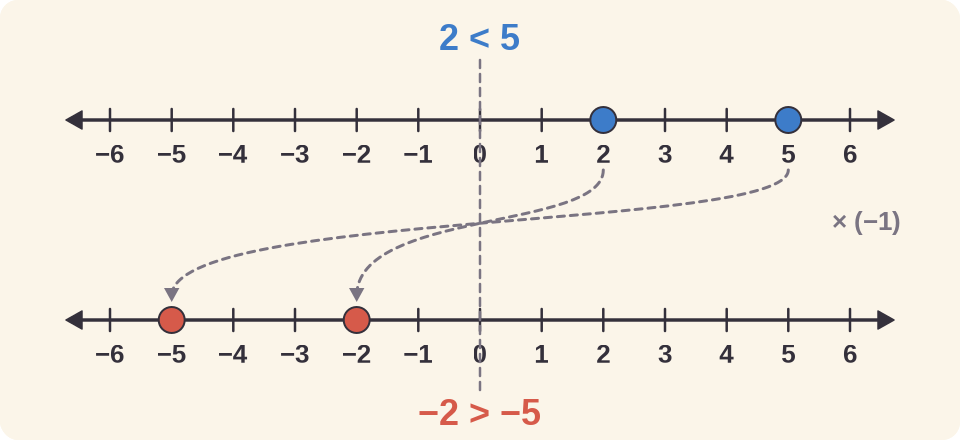
2 is less than 5. Multiply both by −1 and you get −2 and −5. But −2 is greater than −5. Multiplying by a negative number turns an order around.
Why the sign flips
Multiplying by −1 takes every number to its opposite, the same distance on the other side of 0. That is like seeing the number line in a mirror: what was on the right is now on the left.
So becomes . The same happens for any negative number, and for dividing by a negative: , but dividing by −3 gives .
The rule
When you multiply or divide both sides of an inequality by a negative number, flip the sign: becomes , and becomes .
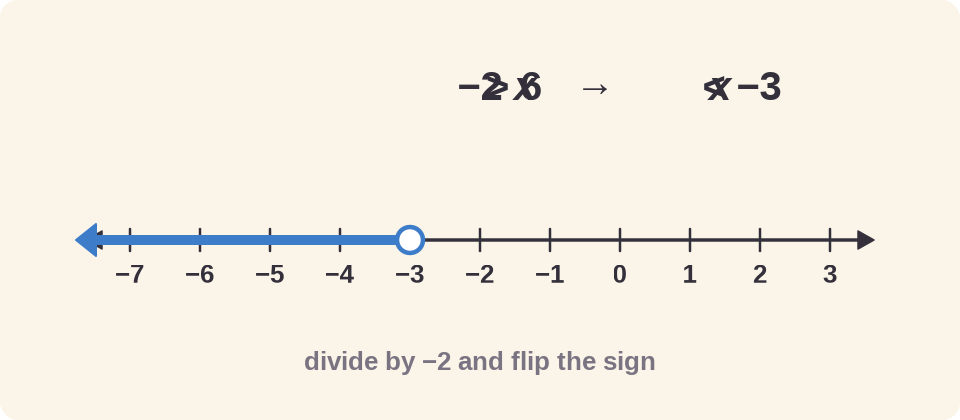
: divide both sides by −2 and flip: . Test −4: −2 × (−4) = 8, and 8 > 6. It works. Test 0: 0 is not greater than 6, and 0 is not in the set.
A two-step example
: take 5 from both sides, . Divide by −3 and flip: .
Adding or subtracting never flips the sign, even a negative number. Only multiplying or dividing by a negative does.
Careful
Flip only for multiplying or dividing by a negative. In , adding 4 gives with no flip.
Try it at home
- Write a true inequality with two numbers, like 3 < 8.
- Multiply both sides by 2, then by −2, and write down whether each result is still true.
- Try it with dividing, and with a number line to see the mirror.
Words in this lesson
- flip - to turn < into > (or ≤ into ≥) when both sides are multiplied or divided by a negative number.
- opposite - the number the same distance from 0 on the other side: the opposite of 5 is −5.
Big idea
Multiplying or dividing both sides by a negative number turns the order around, so flip the inequality sign.