Adding on a Number Line
At 6 a.m. it is 4 degrees. By noon the temperature has dropped 6 degrees. What is it now? Adding a negative number is a move on the number line, and two moves tell you where you land.
Each number is a move
Think of every signed number as a move along the number line. A positive number moves right; a negative number moves left. Its size says how far.
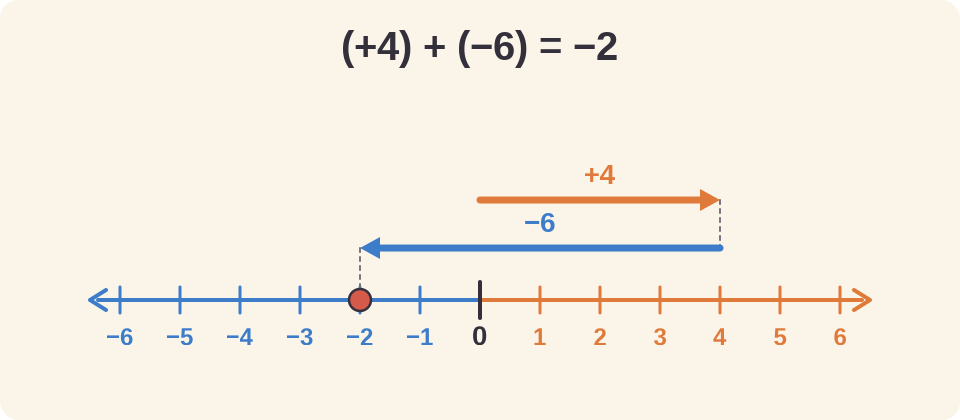
To add (+4) + (−6), start at 0. The first move, +4, takes you to 4. The second move starts where the first one ended and goes 6 to the left. You land on −2.
So (+4) + (−6) = −2. The temperature at noon is −2 degrees.
Two negative moves
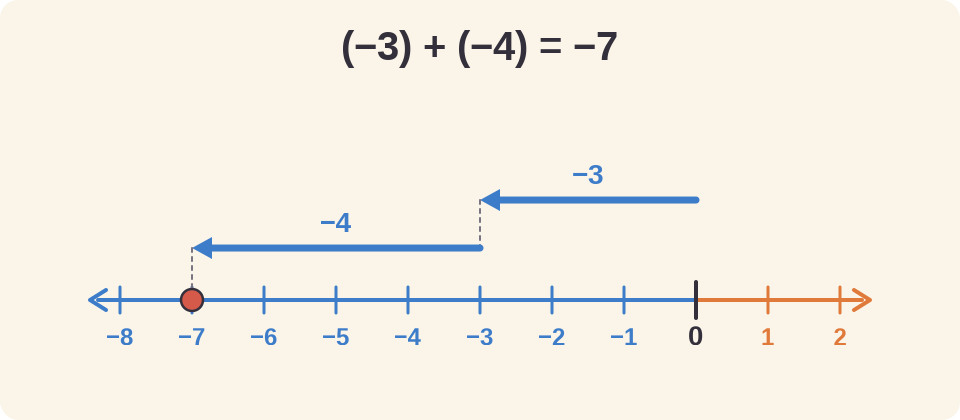
(−3) + (−4) is two moves to the left: 3 steps, then 4 more. You end 7 steps left of 0, at −7.
Moves in the same direction pile up. Moves in opposite directions undo each other, partly or completely.
Back where you started
(+5) + (−5) moves 5 right and then 5 left. You are back at 0. A number and its opposite, the same size with the other sign, always add to 0.
The order of the moves does not matter: (−6) + (+4) lands on −2 too, just like (+4) + (−6).
Try it at home
- Draw a number line from −10 to 10 on a long strip of paper.
- Put a coin on 0. Roll a die twice: an even roll is a move right, an odd roll a move left, by the number rolled.
- Write each turn as a sum, like (+4) + (−3) = 1, and check it on the line.
Words in this lesson
- signed number - a number with a sign: positive numbers are right of 0, negative numbers left of 0.
- opposite - the number the same distance from 0 on the other side: the opposite of 6 is −6.
Big idea
To add signed numbers, make one move for each: right for positive, left for negative, the second starting where the first ends.