Translations on a Grid
Slide a book across your desk. It doesn't turn or flip over: it just moves.
Three moves
There are three ways to move a shape without changing it.
A translation (a slide): the shape moves, but it doesn't turn.
A rotation (a turn): the shape spins about a point.
A reflection (a flip): the shape flips over a mirror line, like a picture in a mirror.
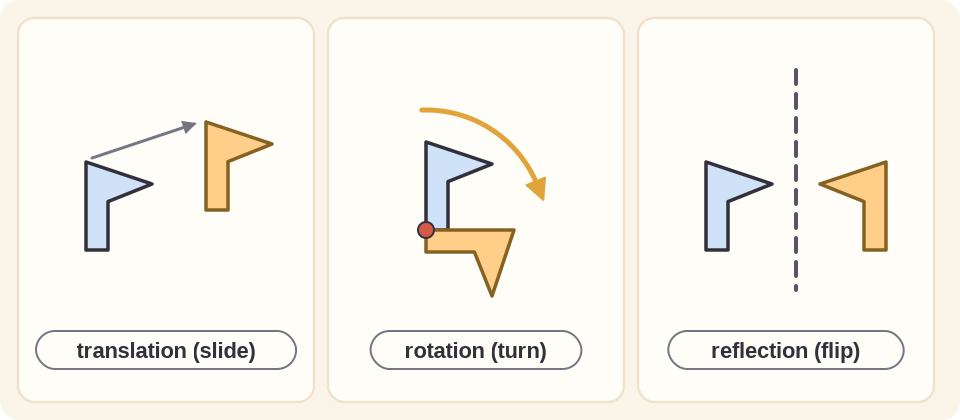
After each move, the new shape has the same size and shape: it is congruent to the old one. Only a flip makes it face the other way: a left footprint slid or turned is still a left footprint, but flipped, it fits a right foot.
Sliding on a grid
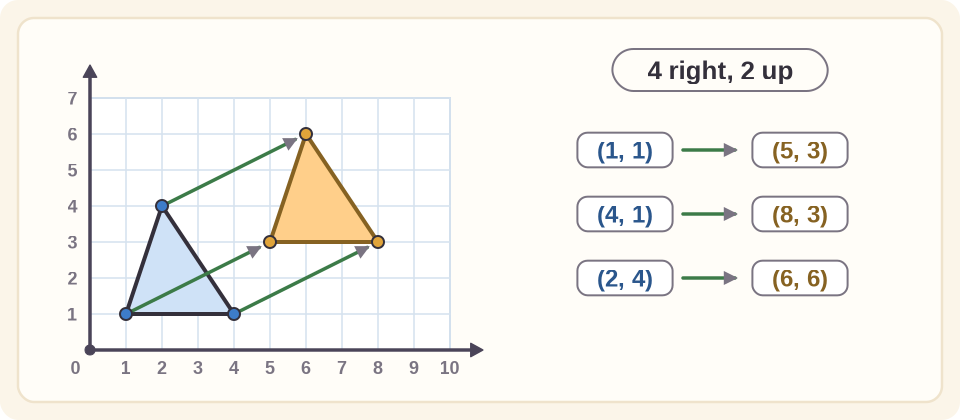
To translate a shape on a grid, move every corner the same number of squares in the same direction.
Here each corner moves 4 right and 2 up. All the arrows are the same.
Sliding with coordinates
With coordinates, 4 right adds 4 to the first number, and 2 up adds 2 to the second.
(1, 1) goes to (5, 3). (4, 1) goes to (8, 3). (2, 4) goes to (6, 6).
A slide left or down subtracts instead.
Try it at home
- Cut a shape from cardboard and trace it on grid paper.
- Slide it 3 right and 1 up, and trace it again.
- Flip it over and trace it. Which tracing faces the other way?
Words in this lesson
- translation - a slide: every point moves the same distance in the same direction.
- congruent - the same shape and the same size.
- reflection - a flip over a mirror line.
Big idea
Slides, turns and flips move a shape without changing its size or shape; in a slide every point moves the same way.