Equivalent Expressions
Kai says 2(x + 4) and 2x + 8 are the same. Lily says 2(x + 4) and 2x + 4 are the same. How can you tell who is right without knowing x?
Same value for every number
Two expressions are equivalent if they give the same value whatever number the letter stands for.
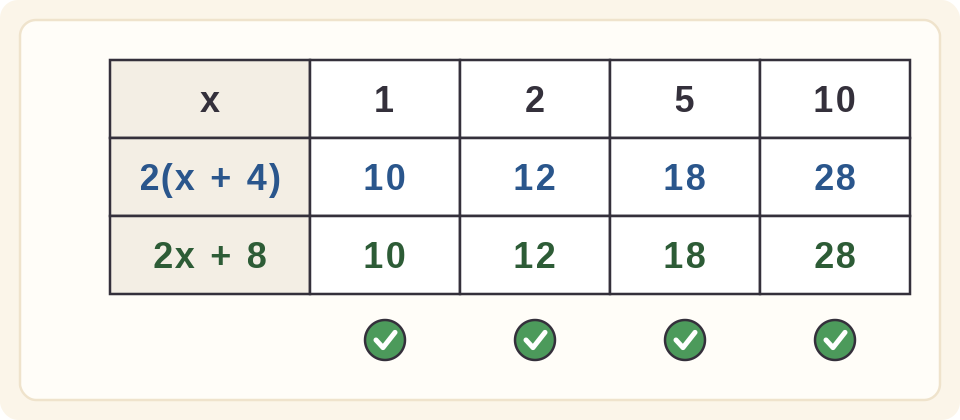
Try a few: x = 1 gives 2(1 + 4) = 10 and 2 × 1 + 8 = 10. x = 5 gives 18 and 18. They keep matching.
And the distributive property shows why: 2(x + 4) = 2x + 8 for every x. Kai is right.
One number can show they are not
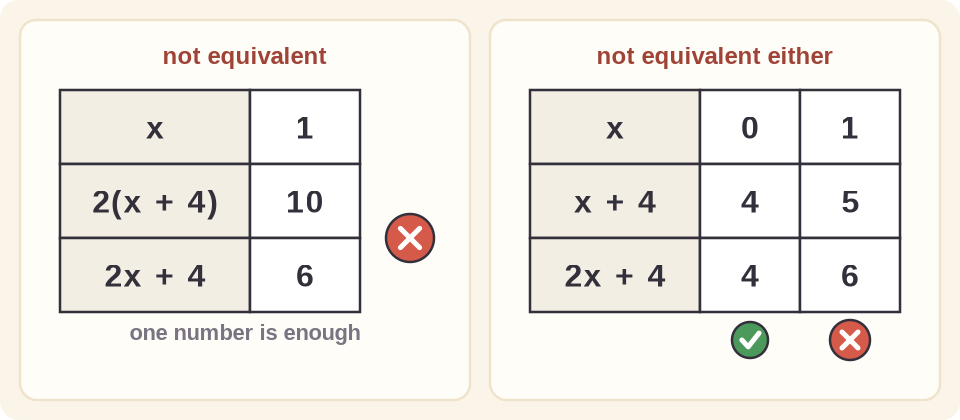
For Lily's pair, x = 1 gives 2(1 + 4) = 10 but 2 × 1 + 4 = 6. One number that gives different values is enough: they are not equivalent.
Careful the other way: x + 4 and 2x + 4 both give 4 when x = 0, yet they are not equivalent. With x = 1 they give 5 and 6.
Using the rules
To make an equivalent expression, use the rules you know: 3(x + 2) + x = 3x + 6 + x = 4x + 6.
Try it at home
- Write 4(y + 1) on one card and 4y + 4 on another.
- Put in y = 0, 1, 2 and 3 and write both values each time.
- Then try 4y + 1. At which number do the values first differ?
Words in this lesson
- equivalent expressions - expressions that have the same value for every number put in, like 2(x + 4) and 2x + 8.
Big idea
Equivalent expressions match for every number; one number that gives different values shows they are not equivalent.