Unit Price and the Better Buy
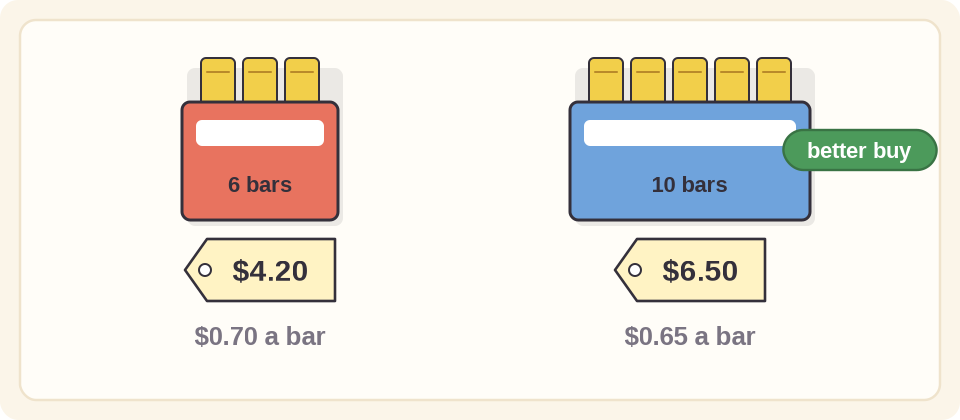
A box of 6 granola bars costs $4.20. A box of 10 costs $6.50. Which box gives you more for your money?
Price for one
The unit price is the price for 1 of something: one bar, one ounce, one liter. It is a unit rate in dollars.
Small box: $4.20 ÷ 6 = $0.70 a bar. Big box: $6.50 ÷ 10 = $0.65 a bar.
The big box costs less per bar, so it is the better buy, even though it costs more in all.
From the unit price to any amount
Grapes cost $3 a pound. How much do 4 pounds cost? 4 × $3 = $12.
How many pounds can you buy with $18? Divide: 18 ÷ 3 = 6 pounds.
Is bigger always better?
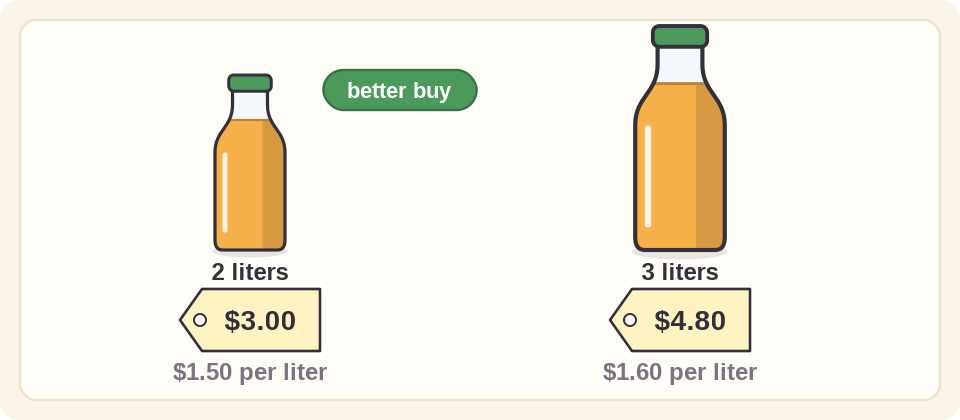
Juice comes in a 2-liter bottle for $3.00 and a 3-liter bottle for $4.80.
Per liter: $3.00 ÷ 2 = $1.50 and $4.80 ÷ 3 = $1.60. Here the small bottle is the better buy.
Try it at home
- Find two sizes of the same food at home or in a shop flyer.
- Divide each price by its amount to find the unit price.
- Which size is the better buy?
Words in this lesson
- unit price - the price for one unit, like dollars per bar or per pound.
- better buy - the one with the lower unit price.
Big idea
Compare unit prices, not total prices, to find the better buy.