Taking Out the GCF
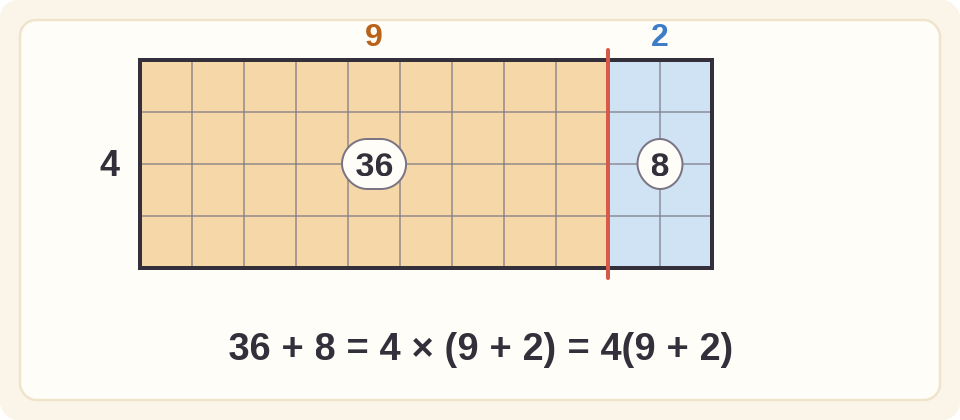
36 + 8 is a sum of two numbers, and both are in the 4 times table. Can you write the sum as 4 times something?
Take out the GCF
The GCF of 36 and 8 is 4. So 36 = 4 × 9 and 8 = 4 × 2.
So 36 + 8 = 4 × (9 + 2). A number right before parentheses means times, so we also write 4(9 + 2).
This is the distributive property, used backward. Writing a sum this way is factoring it.
Check by multiplying back
Multiply the 4 by each number inside: 4 × 9 = 36 and 4 × 2 = 8. That is 36 + 8 again.
Take out the greatest common factor, not just any. 2(18 + 4) is true, but 18 and 4 still share a 2.
With the GCF out, the numbers inside share only 1. Another: 24 + 40 = 8(3 + 5).
Simplify a fraction in one step
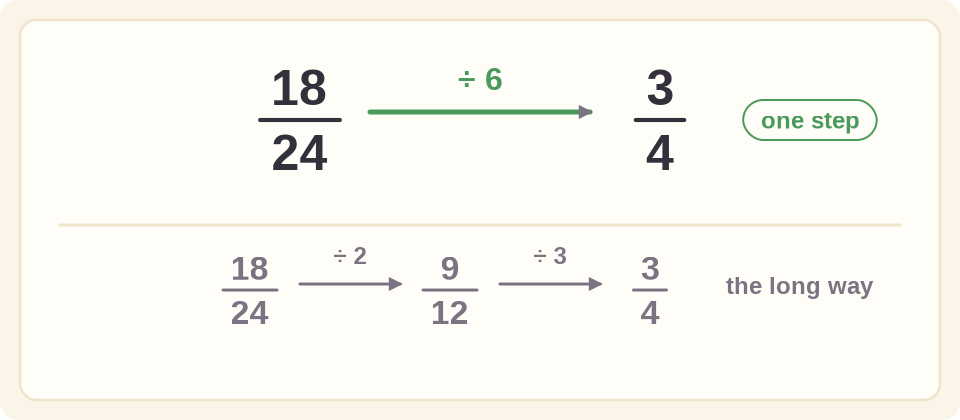
To simplify , divide its top and bottom by their GCF, 6.
= in one step. 3 and 4 share only 1, so it is in simplest form.
Try it at home
- Draw a rectangle 3 squares tall and 7 squares wide on grid paper. Draw a line after 5 columns.
- Count the squares in each part: 15 and 6.
- Write 15 + 6 as 3 × (5 + 2), and check it by multiplying back.
Words in this lesson
- distributive property - a number times a sum is the same as the number times each part, added: 4(9 + 2) = 36 + 8.
- factor a sum - to write it as a number times a sum in parentheses.
Big idea
Take the GCF out of a sum, 36 + 8 = 4(9 + 2), and check it by multiplying back.