Writing Equations for Stories
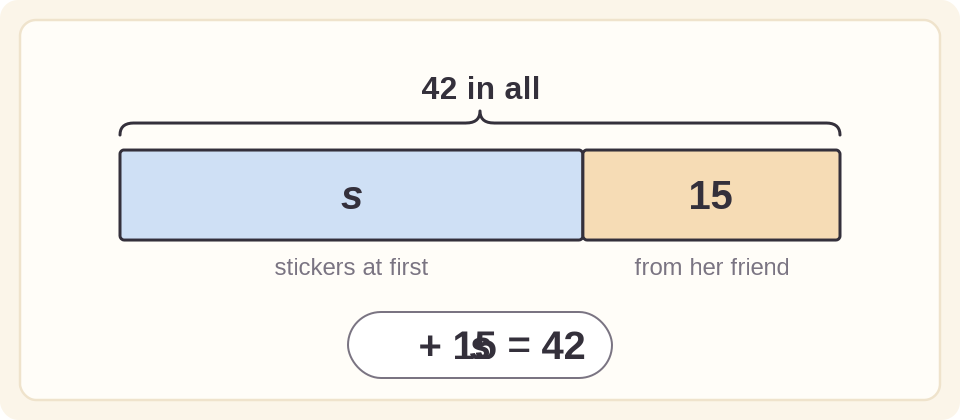
Sofia had some stickers. Her friend gave her 15 more, and now she has 42. Before an equation can help you, you have to write one.
Three steps
First, choose a letter for the number you don't know and say what it means: is the number of stickers Sofia had at first.
Next, write what the story says: , plus 15, makes 42. So .
Last, solve and check: , and . Sofia had 27 stickers.
Equal groups
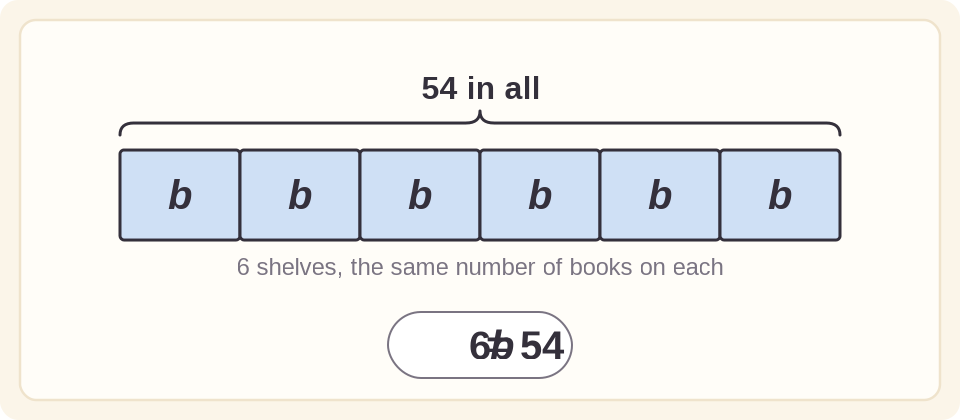
A bookcase has 6 shelves with the same number of books on each, 54 books in all. Let be the number of books on one shelf.
6 shelves of books make 54: . Divide both sides by 6: .
Which operation?
Read what happens in the story. Something added or joined: plus. Taken away or spent: minus. Equal groups: times. Shared equally: divided by.
"Mia spent 8 dollars and has 19 dollars left" is , where is the money she had before.
Try it at home
- Make up a story about something you collect, with one number missing.
- Choose a letter for the missing number and write the equation.
- Swap stories with someone and solve each other's.
Words in this lesson
- unknown - the number a story doesn't tell you, written as a letter.
- tape diagram - a bar cut into parts that shows how the numbers in a story fit together.
Big idea
Name the unknown with a letter, write what the story says as an equation, then solve it and check.