Reflecting Points Across an Axis
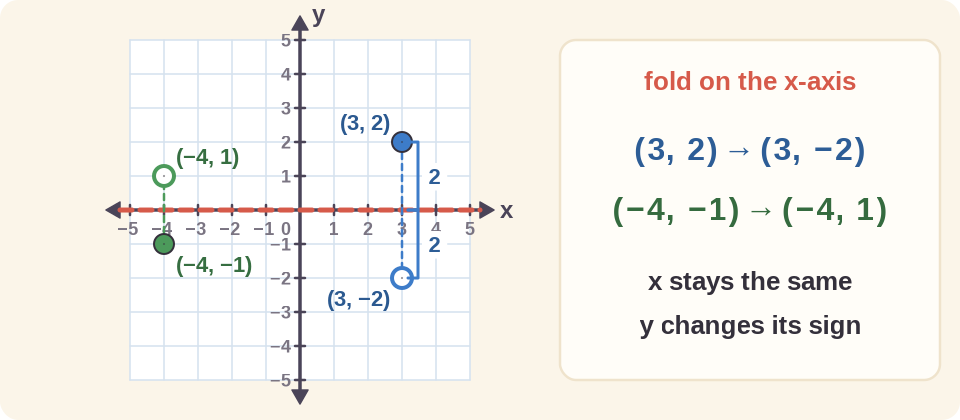
Mark the point (3, 2) on squared paper. Fold the paper along the x-axis and poke a pin through the point. Where does the hole on the other side come out?
Across the x-axis
(3, 2) is 2 units above the x-axis. Its mirror image is 2 units below it, straight down: (3, −2).
The point does not move left or right, so x stays the same. Only the sign of y changes.
(−4, −1) reflected across the x-axis is (−4, 1).
Across the y-axis
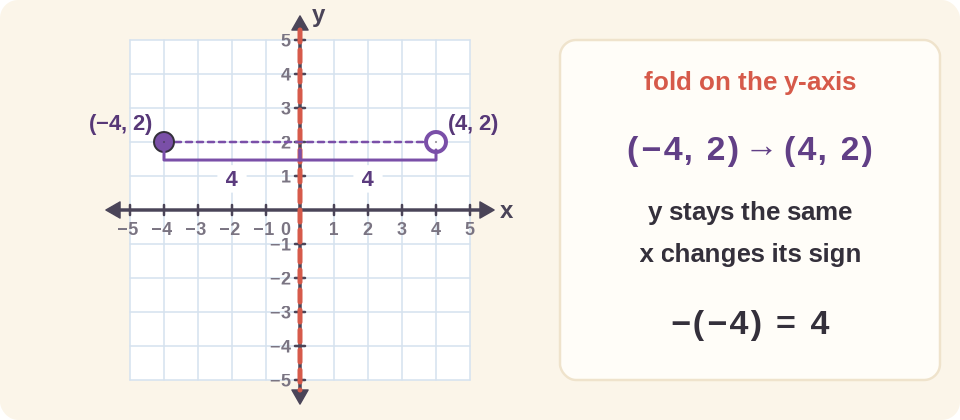
Now fold along the y-axis. (−4, 2) is 4 units left of it, so its image is 4 units right: (4, 2).
This time y stays the same and only the sign of x changes.
Changing a sign gives the opposite number. The opposite of −4 is 4, and the opposite of 4 is −4. We write −(−4) = 4.
Across both
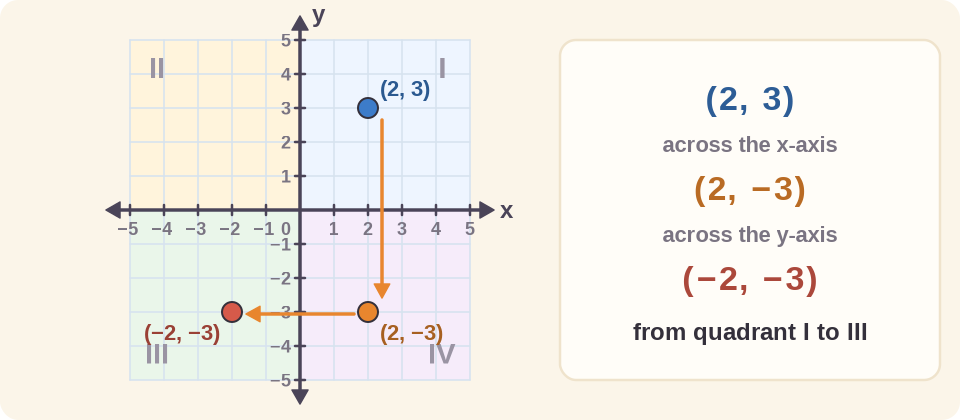
Reflect (2, 3) across the x-axis: (2, −3). Then reflect that across the y-axis: (−2, −3).
Both signs changed, and the point ended up in the opposite quadrant, from I to III.
Try it at home
- Mark (1, 4) on squared paper with axes through the middle.
- Fold along the x-axis and prick the point through. Write the hole's coordinates.
- Unfold, fold along the y-axis, and do it again.
Words in this lesson
- reflection - a mirror image: the point flipped over a line to the same distance on the other side.
- opposite - the number the same distance from 0 on the other side, like 4 and −4.
Big idea
Reflecting across the x-axis changes the sign of y; across the y-axis, the sign of x.