Surface Area of a Box
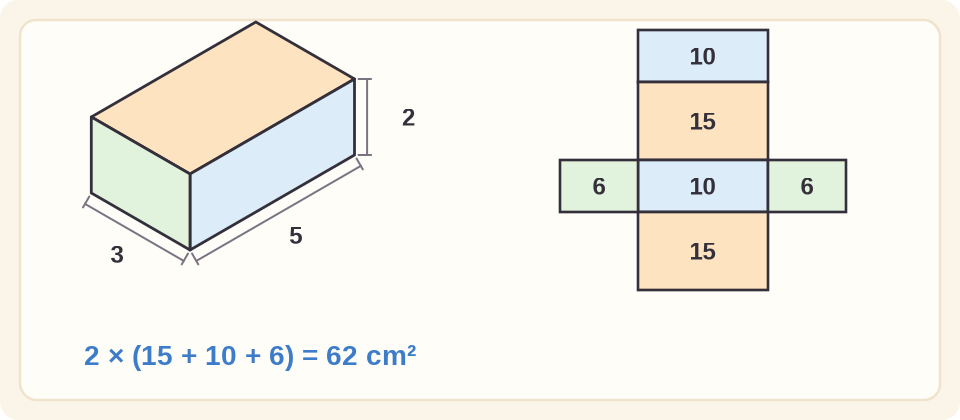
Ana is covering a box 5 cm long, 3 cm wide and 2 cm tall with colored paper. How much paper does she need?
Three pairs of faces
A box has three pairs of faces the same size: top and bottom, front and back, the two ends.
Top and bottom: 5 × 3 = 15 each. Front and back: 5 × 2 = 10 each. Ends: 3 × 2 = 6 each.
Add one of each, then double: 2 × (15 + 10 + 6) = 2 × 31 = 62 cm².
A cube is a box with 6 equal faces, so its surface area is 6 × (edge × edge).
A box with no lid
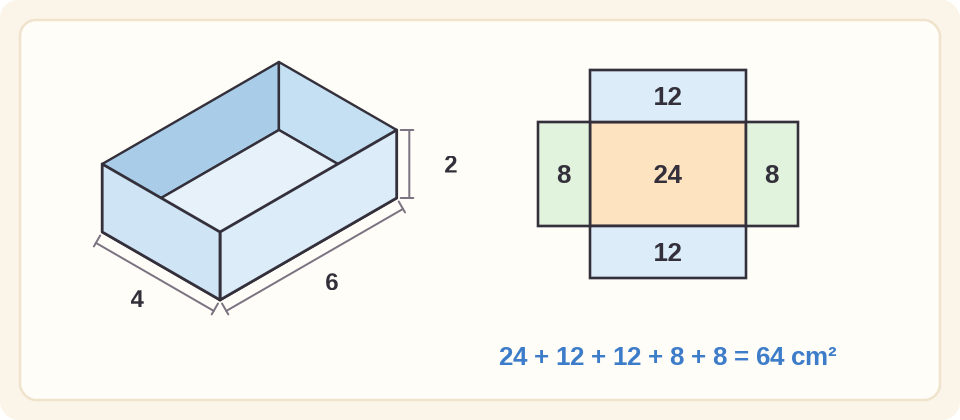
A tray or an open box has only 5 faces. Take the top away.
An open box 6 cm long, 4 cm wide and 2 cm tall: the bottom is 24, the long sides 12 each, the short sides 8 each.
24 + 12 + 12 + 8 + 8 = 64 cm². With a lid it would be 88.
Try it at home
- Find a small box and measure its length, width and height.
- Work out the area of each pair of faces.
- Add them and double. Check by wrapping it in paper.
Words in this lesson
- pair of faces - two faces of a box that are opposite each other and the same size.
Big idea
A box's surface area is twice the sum of its three different faces; leave one out for a box with no lid.