Surface Area from a Net
How much paper does it take to wrap a cube exactly, with nothing left over? Unfold the cube into its net, and the answer is the area of the net.
Add up the faces
The total area of all the faces of a solid is its surface area. It is the area of its net.
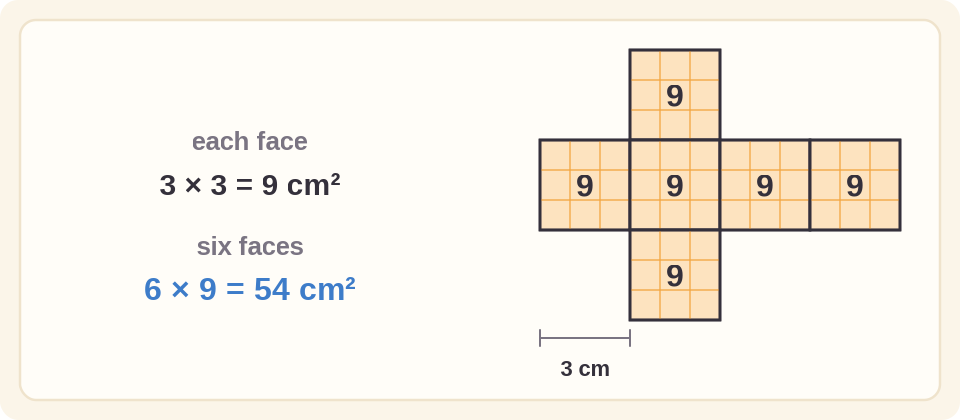
A cube with edges of 3 cm has 6 square faces. Each is 3 × 3 = 9 cm².
So its surface area is 6 × 9 = 54 cm². Square units, because it is a flat cover, not a space inside.
Count on squared paper
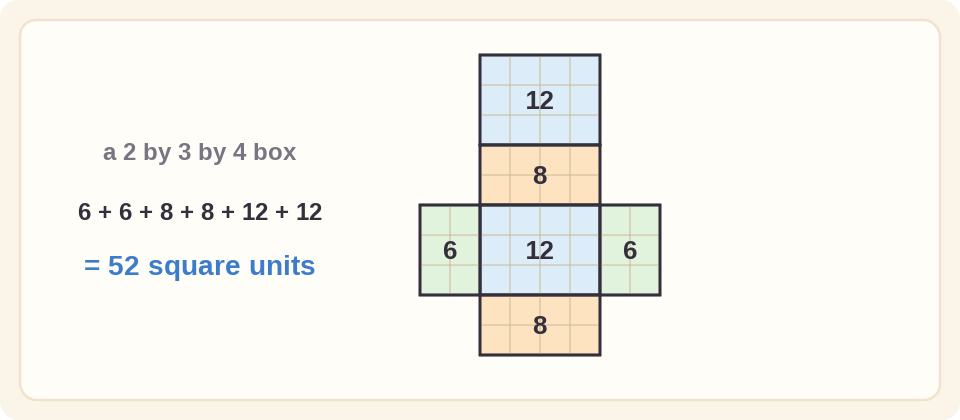
A net drawn on squared paper can be counted. This box's net has faces of 6, 6, 8, 8, 12 and 12 squares.
6 + 6 + 8 + 8 + 12 + 12 = 52 square units.
A can's net
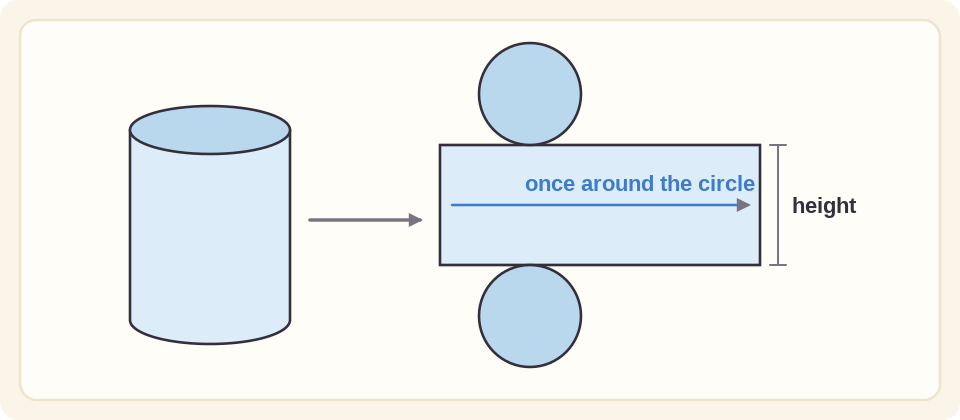
A can's net is two circles and a rectangle. The rectangle wraps once around the circle, so its long side is as long as the distance around the circle, the circumference. Its short side is the can's height.
Try it at home
- Draw a cube's net on squared paper, each face 2 by 2 squares.
- Count the squares of the whole net.
- Cut it out and fold it. The paper covers the cube exactly.
Words in this lesson
- surface area - the total area of all the faces of a solid; the area of its net.
- circumference - the distance once around a circle.
Big idea
The surface area of a solid is the area of its net: add the areas of all its faces.