Polygons on the Coordinate Plane
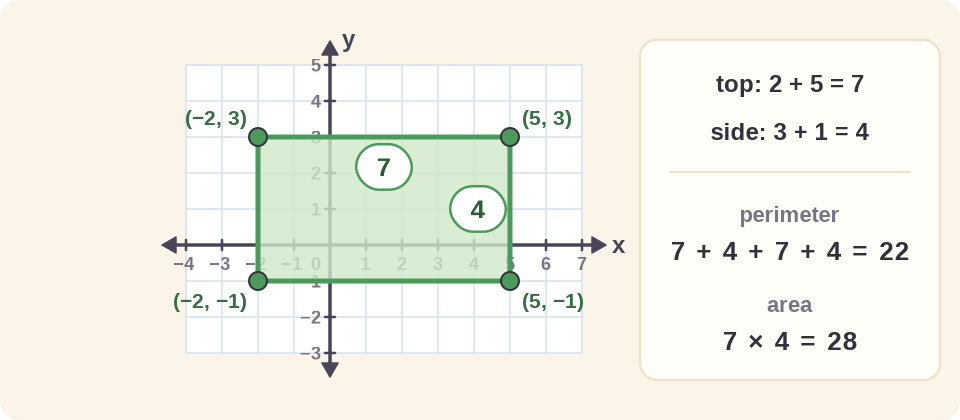
Leo plans a garden on a grid where each square is 1 meter. Its corners are at (−2, 3), (5, 3), (5, −1) and (−2, −1). How much fence does he need to go all the way around?
Plot the corners in order
Mark the four points and join them in the order they are listed, then back to the first. The garden is a rectangle.
Side lengths from the corners
The top side goes from (−2, 3) to (5, 3). The signs of x differ, so add: 2 + 5 = 7 meters.
The right side goes from (5, 3) to (5, −1). The signs of y differ: 3 + 1 = 4 meters.
The fence is all four sides: 7 + 4 + 7 + 4 = 22 meters. That is the perimeter.
The area is 7 × 4 = 28 square meters.
Find a missing corner
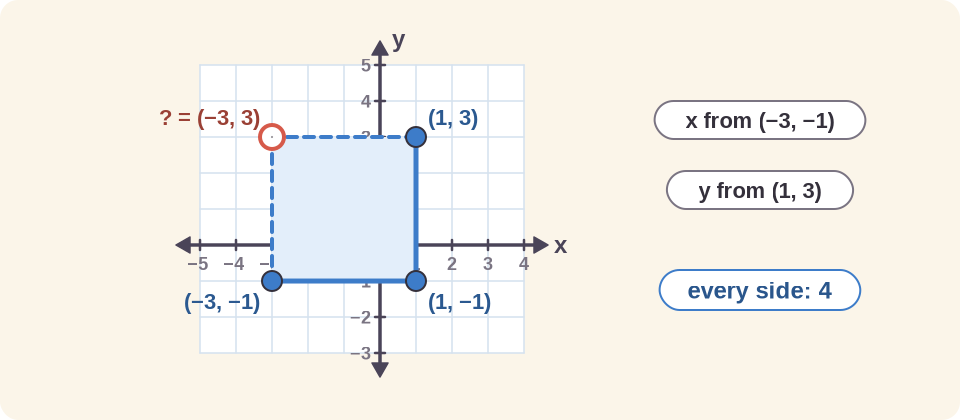
A square has three corners at (−3, −1), (1, −1) and (1, 3). Where is the fourth?
It must be straight above (−3, −1) and level with (1, 3). So it takes x from the first and y from the last: (−3, 3).
Check the sides: from −3 to 1 is 4, and from −1 to 3 is 4. All four sides are 4 units, so it is a square.
Try it at home
- Draw a rectangle on squared paper with axes, with one corner in each quadrant.
- Write the coordinates of its corners.
- Find its side lengths from the coordinates, then count the squares to check.
Words in this lesson
- polygon - a flat shape with straight sides, like a triangle or a rectangle.
- perimeter - the distance all the way around a shape.
Big idea
With coordinates, you can find a shape's side lengths, perimeter and area without measuring.