Area of Trapezoids
A ramp seen from the side has a long bottom, a shorter top, and a top and bottom that are parallel. This shape is a trapezoid. How much space does it cover?
Two trapezoids make a parallelogram
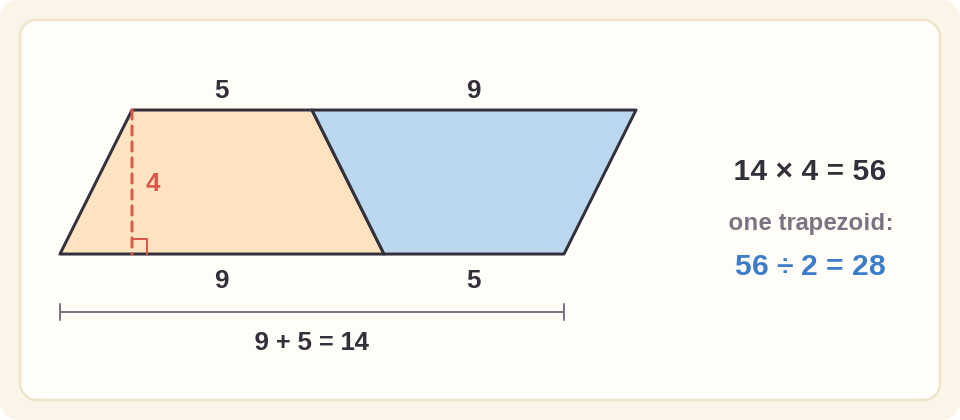
Take a trapezoid with parallel sides 9 cm and 5 cm and a height of 4 cm. Turn a copy upside down and put it next to the first.
Together they make a parallelogram. Its base is 9 + 5 = 14 cm, and its height is still 4 cm.
The parallelogram's area is 14 × 4 = 56 cm². One trapezoid is half of that: 28 cm².
So the area of a trapezoid is × (the sum of the parallel sides) × height.
A rhombus: use the diagonals
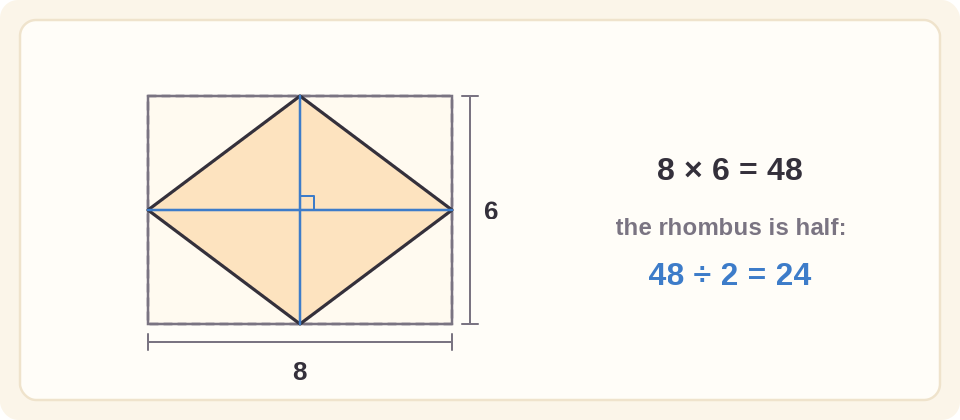
A rhombus has four equal sides. Its two diagonals cross at a right angle.
Draw a rectangle around it, as wide as one diagonal and as tall as the other. The rhombus covers half of it.
Diagonals 8 cm and 6 cm: × 8 × 6 = 24 cm².
This works backward too. A rhombus of 30 cm² with one diagonal of 10 cm: 10 × ? = 60, so the other diagonal is 6 cm.
Try it at home
- Cut two copies of a trapezoid from paper.
- Fit them into a parallelogram and measure its base and height.
- Is one trapezoid half of the parallelogram?
Words in this lesson
- trapezoid - a four-sided shape with one pair of parallel sides.
- rhombus - a four-sided shape with all four sides the same length.
Big idea
Two copies of a trapezoid make a parallelogram, so its area is half of (top + bottom) × height.