Theoretical Probability
A bag holds 2 red, 3 blue and 5 green marbles. You take one without looking. What is the probability that it is green? You can work it out without taking a single marble.
Count the outcomes
Each way something can come out is an outcome. Each of the 10 marbles is one outcome, all equally likely.
5 of the 10 outcomes are green. So the probability of green is = = 0.5.
Probability = outcomes in the event ÷ all the outcomes. This is the theoretical probability: worked out by thinking, not by trying.
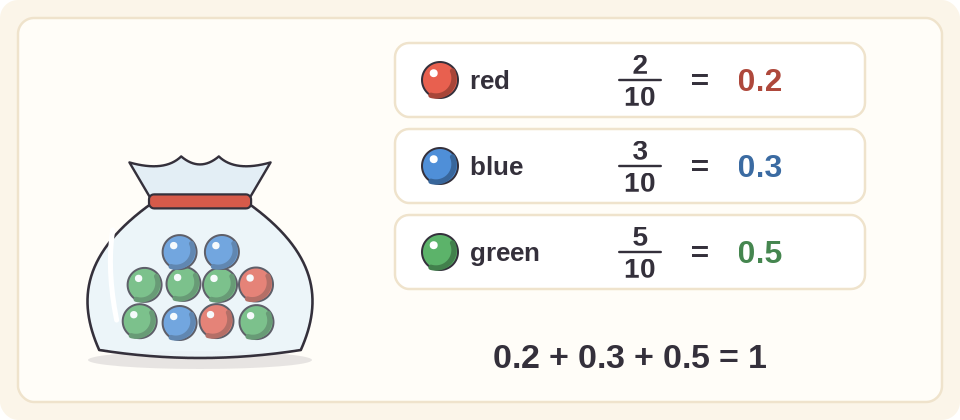
They add up to 1
Red is = 0.2 and blue is = 0.3. Add all three: 0.2 + 0.3 + 0.5 = 1.
The marble must be one of the three colors, so the probabilities of all the outcomes always add up to 1.
That gives a shortcut: the probability of not green is 1 − 0.5 = 0.5.
A die
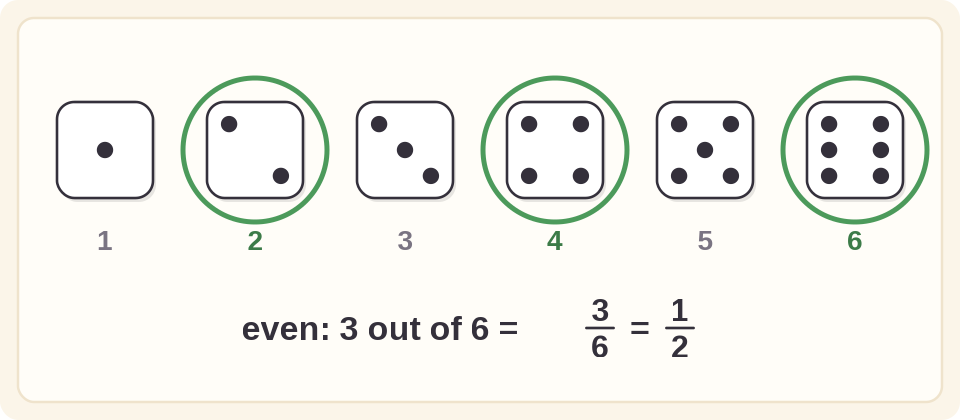
A die has 6 equally likely outcomes. Even numbers are 2, 4 and 6: 3 of the 6. The probability of an even number is = .
A number bigger than 4 is 5 or 6: = . Not bigger than 4 is 1 − = .
Try it at home
- Put 10 small things in a bag: 1 of one color, 4 of another, 5 of a third.
- Write each color's probability as a decimal.
- Do they add up to 1?
Words in this lesson
- outcome - one way something can come out, like a 4 on a die.
- theoretical probability - a probability worked out by counting equally likely outcomes.
Big idea
Theoretical probability is the outcomes in the event out of all the equally likely outcomes; all of them together make 1.