Absolute Value
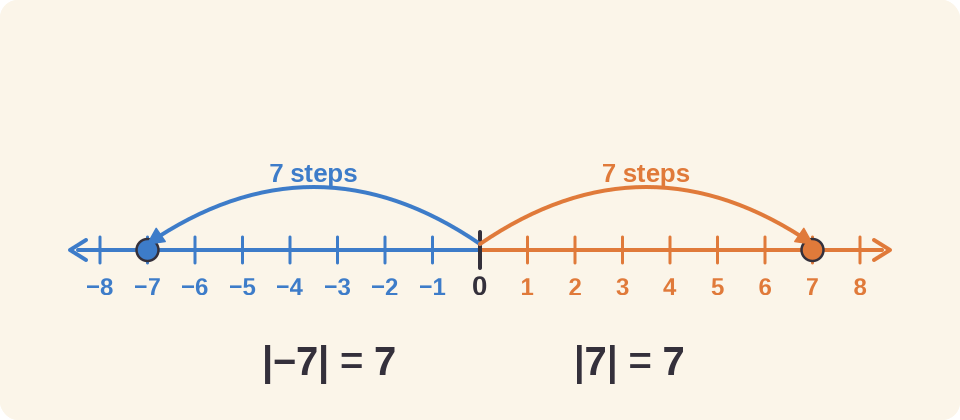
−7 and 7 are on different sides of zero, but both are 7 steps away from it. Is there a name for that distance?
Distance from zero
A number's absolute value is its distance from 0 on the number line.
We write it between two straight bars: |−7| = 7 and |7| = 7.
|0| = 0. A distance is never negative, so an absolute value is never negative.
Opposites have the same absolute value: |−2.5| = |2.5| = 2.5.
A smaller number, a bigger absolute value
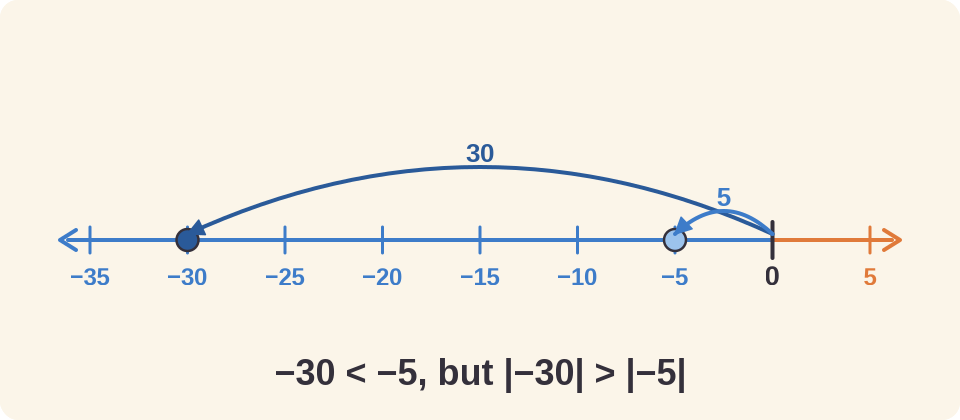
−30 < −5, since −30 is further left.
But |−30| = 30 and |−5| = 5, so |−30| > |−5|. −30 is further from zero.
For negative numbers, the smaller the number, the bigger its absolute value.
Careful
|−7| is 7, not −7. The bars ask how far, never which way.
Try it at home
- Draw a number line from −10 to 10.
- Put a finger on 0 and count the steps to −8. That count is |−8|.
- Find the two numbers whose absolute value is 6.
Words in this lesson
- absolute value - a number's distance from 0: |−7| = 7.
Big idea
Absolute value is distance from zero: |−7| = 7, and it is never negative.