Area of Parallelograms
A garden bed is shaped like a slanted rectangle: a parallelogram, with two pairs of parallel sides. You know how to find a rectangle's area. Can you turn this shape into one?
Cut and slide
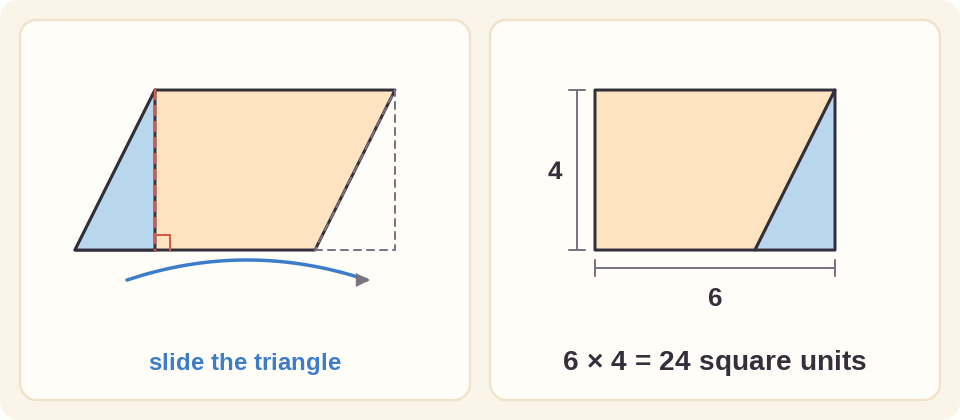
Draw a line straight down from one top corner. It cuts a triangle off one end.
Slide that triangle to the other end. It fits exactly, and the shape is now a rectangle.
The area stayed the same. The rectangle is as long as the parallelogram's base and as tall as its height.
So the area of a parallelogram is base × height: A = bh.
The height goes straight up
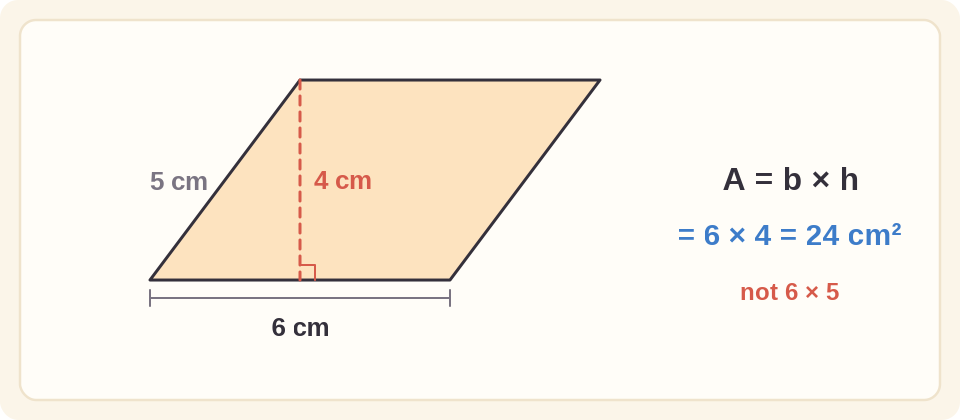
The height is how far the top is from the base, measured at a right angle to the base. It is not the slanted side.
This parallelogram has a base of 6 cm, a slanted side of 5 cm and a height of 4 cm. Its area is 6 × 4 = 24 cm², not 6 × 5.
Count to check
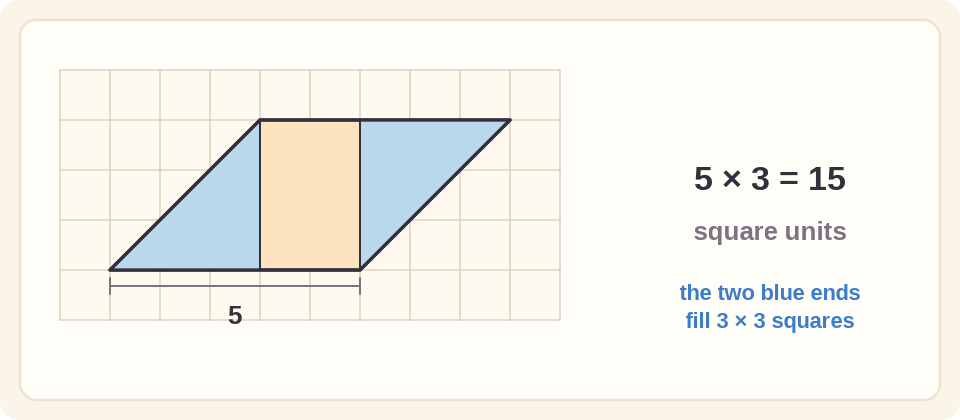
On squared paper, a parallelogram with base 5 and height 3 covers 5 × 3 = 15 squares: the part squares at its ends fit together.
Try it at home
- Draw a parallelogram on squared paper and cut it out.
- Cut straight down from one top corner and move the triangle to the other end.
- Measure the rectangle you made. Is its area base × height?
Words in this lesson
- parallelogram - a four-sided shape whose opposite sides are parallel.
- base - the side you measure from; any side can be the base.
- height - the distance from the base to the opposite side, measured at a right angle to the base.
Big idea
A parallelogram can be cut and moved into a rectangle, so its area is base × height.