Finding a Percent of a Number
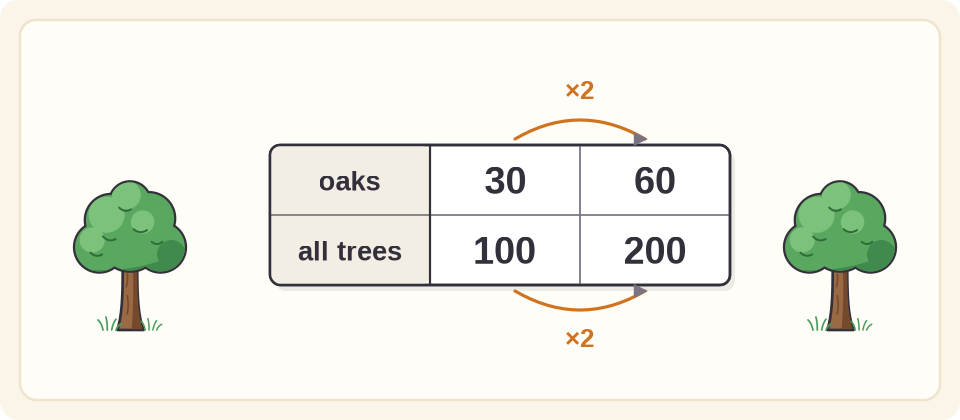
A park has 200 trees, and 30% of them are oaks. How many oak trees are there?
30 out of every 100
30% means 30 out of every 100. 200 is two hundreds, so there are 30 + 30 = 60 oaks.
A ratio table shows the same thing: 30 to 100 is equal to 60 to 200, times 2.
Through 1% or 10%
15% of 400 grams: 1% of 400 is 4, so 15% is 15 × 4 = 60 grams.
Or use 10% and 5%: 10% of 400 is 40, 5% is half of that, 20. And 40 + 20 = 60.
Check by size: 15% is a little more than a tenth, and 60 is a little more than 40.
Discounts and what is left
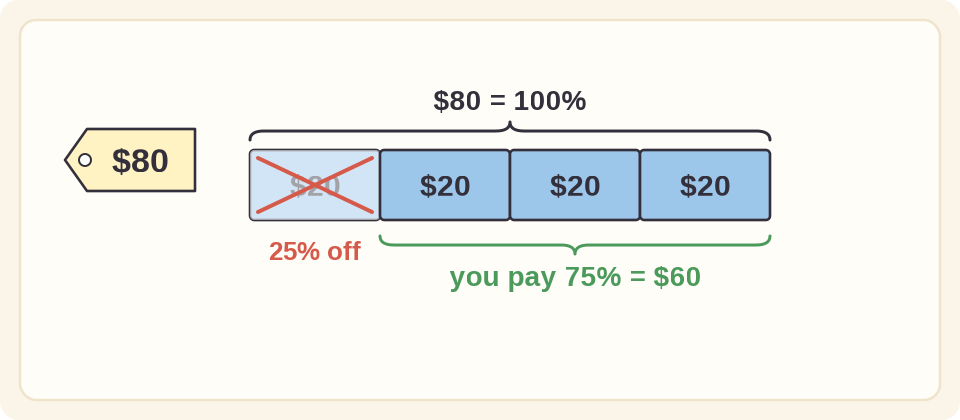
A bag costs $80 and is 25% off. 25% is a quarter, so the discount is 80 ÷ 4 = $20.
You pay 80 − 20 = $60. That is the other 75%.
A forest of 5,000 trees has 60% pines. The others are 100% − 60% = 40%, and 40% of 5,000 is 2,000 trees.
Try it at home
- Find a price at home or in a flyer.
- Work out 10% of it, then 20% and 5%.
- What would the price be at 25% off?
Words in this lesson
- discount - an amount taken off a price.
- percent of - a part of a number, like 30% of 200, which is 60.
Big idea
To find a percent of a number, think 'out of every 100', or go through 1% or 10%.