From a Table to an Equation
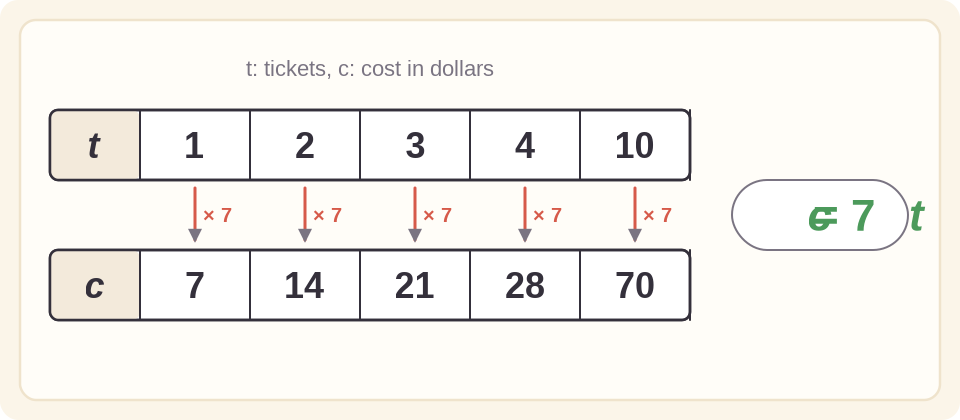
1 movie ticket costs 7 dollars, 2 cost 14 and 3 cost 21. Can you write one rule for the cost of any number of tickets?
Find the rule
Let be the number of tickets (independent) and the cost in dollars (dependent).
7 is 1 times 7, 14 is 2 times 7, 21 is 3 times 7: every cost is 7 times the tickets.
So . Check it on every row, not just one.
Use the rule both ways
How much do 10 tickets cost? dollars.
How many tickets can you buy for 56 dollars? , so .
A table shows some rows; the equation gives every row.
Not every rule multiplies
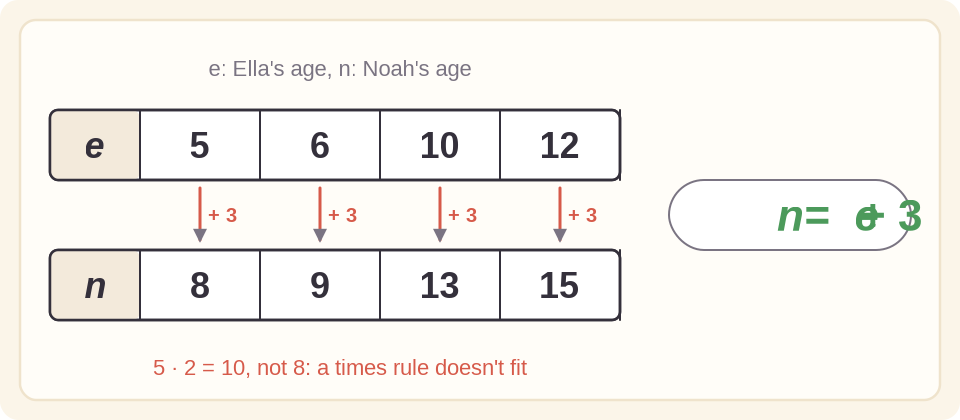
Noah is 3 years older than his sister Ella. Ella's age and Noah's age go 5 and 8, 6 and 9, 10 and 13.
Each is 3 more than its , so .
A times rule doesn't fit: , not 8. Always test your rule on more than one row.
Try it at home
- Count how many legs 1, 2, 3 and 4 dogs have, and write a table.
- Find the rule and write it with letters: d for dogs, l for legs.
- Use your rule to find the legs of 12 dogs, and how many dogs have 40 legs.
Words in this lesson
- table of values - a table that pairs each value of one variable with a value of the other.
- rule - what you do to the independent variable to get the dependent one, written as an equation.
Big idea
To write the equation, find what you do to the independent variable to get the dependent one, and check it on every row.