Distance Between Two Points
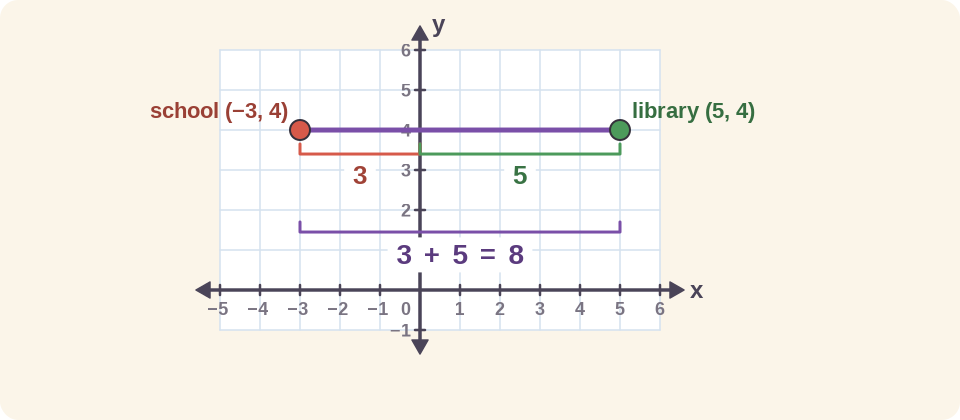
On a town map, City Hall is at the origin and each square is one block. The school is at (−3, 4) and the library is at (5, 4). How many blocks is the walk between them along that street?
Same second number: count across
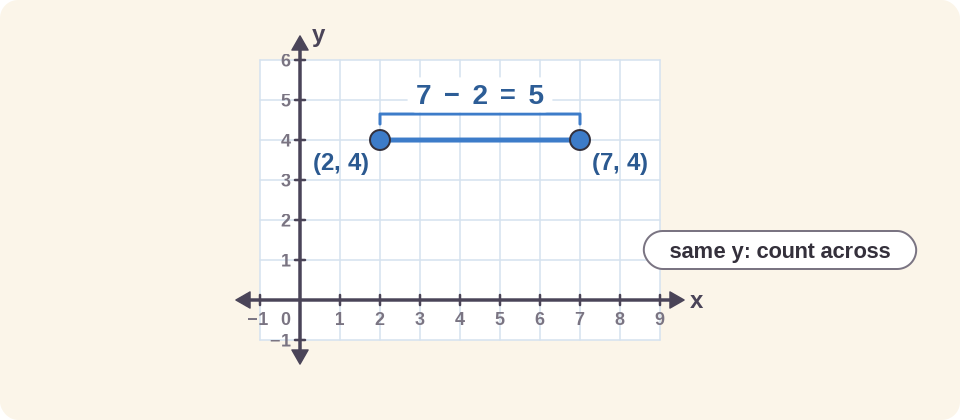
Both points have y = 4, so they lie on the same line across. Only the x-coordinates matter.
If both x-coordinates have the same sign, subtract: from (2, 4) to (7, 4) is 7 − 2 = 5 blocks.
Crossing zero: add
The school is at x = −3, which is 3 blocks left of the y-axis. The library at x = 5 is 5 blocks right of it.
The walk crosses the y-axis, so the two parts add: 3 + 5 = 8 blocks.
The distance of a number from 0 is its absolute value: |−3| = 3 and |5| = 5. When the signs are different, add the absolute values.
Same first number: count up and down
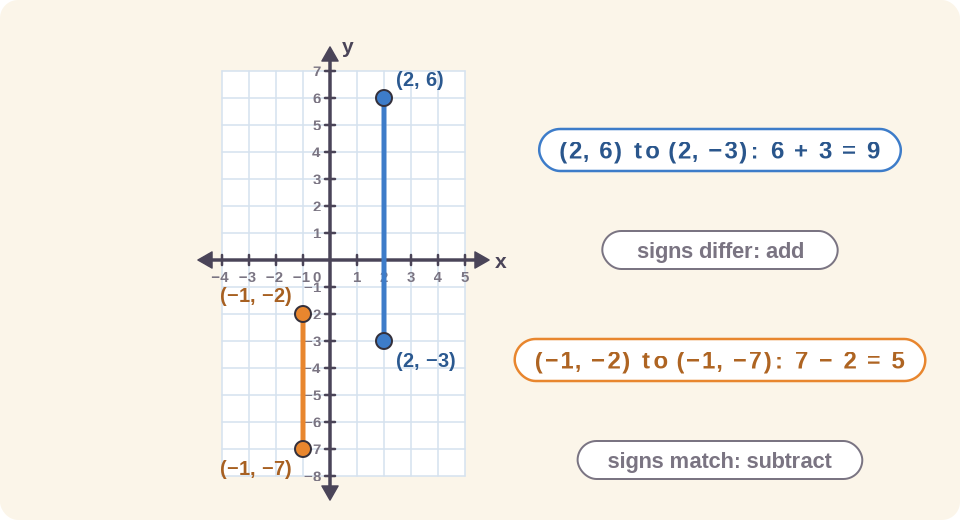
(2, 6) and (2, −3) share x = 2, so they are on one line going up and down. The signs differ: 6 + 3 = 9 units.
(−1, −2) and (−1, −7) are both below the x-axis. Their signs are the same: 7 − 2 = 5 units.
Try it at home
- On squared paper with axes, mark (−4, 2) and (3, 2).
- Count the squares between them.
- Then check: are the signs of the x-coordinates the same or different? Did you add or subtract?
Words in this lesson
- absolute value - how far a number is from 0, never negative: |−3| = 3.
- distance - how far apart two points are, counted in units.
Big idea
For two points on the same line across or up and down, subtract the absolute values if the signs match, and add them if they don't.