Four Quadrants
A treasure map has a well at its center. The chest is 3 steps west and 2 steps south of it. A grid that only goes right and up from 0 has no place for it.
Number lines in both directions
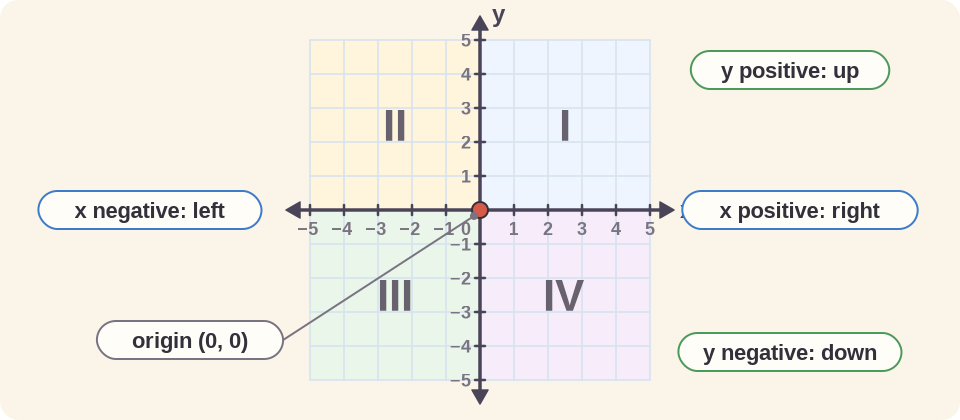
Make the x-axis a whole number line: positive numbers right of 0, negative numbers left.
Make the y-axis one too: positive up, negative down.
The two axes cross at the origin, (0, 0). They cut the plane into four parts called quadrants.
They are numbered I, II, III and IV, counterclockwise from the top right.
Reading a point
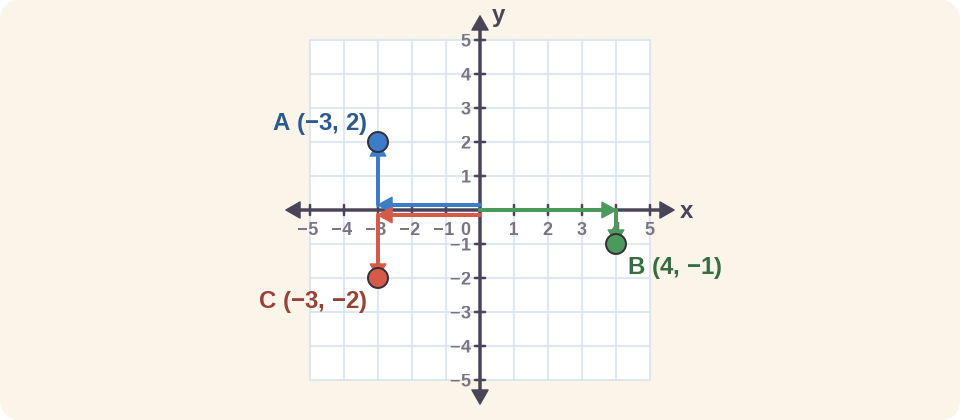
Start at the origin. The first number says how far right (positive) or left (negative).
The second says how far up (positive) or down (negative).
So (−3, 2) is 3 left and 2 up. The treasure, 3 west and 2 south, is at (−3, −2).
The signs tell the quadrant
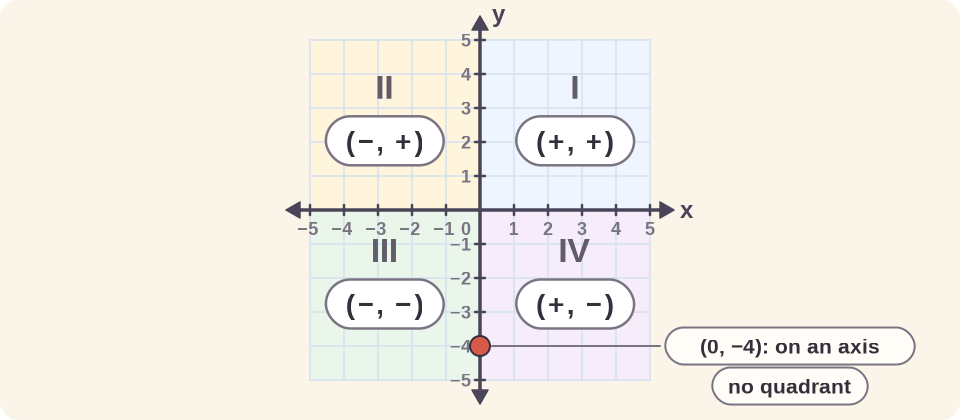
In quadrant I both numbers are positive. In II, x is negative and y is positive.
In III both are negative. In IV, x is positive and y is negative.
A point on an axis, like (0, −4), is in no quadrant.
Try it at home
- Draw axes through the middle of squared paper, numbered −5 to 5.
- Mark (2, 3), (−2, 3), (−2, −3) and (2, −3).
- Which quadrant is each point in? What shape do the four points make?
Words in this lesson
- quadrant - one of the four parts the two axes cut the plane into, numbered I, II, III and IV.
- negative coordinate - a coordinate less than 0: left of the y-axis, or below the x-axis.
Big idea
The signs of a point's two coordinates tell you which way to go from the origin and which quadrant it is in.