Plotting Ratio Pairs
The side of a square and its perimeter make pairs: side 1 cm, perimeter 4 cm; side 2 cm, perimeter 8 cm. What happens when you put these pairs on a grid?
Pairs from a table
Each column of a ratio table is a pair of numbers. Write it as an ordered pair: (side, perimeter).
(1, 4), (2, 8), (3, 12), (4, 16). Plot them: go right by the side, then up by the perimeter.
The points lie on a straight line, and the line goes through (0, 0). A side of 0 has a perimeter of 0.
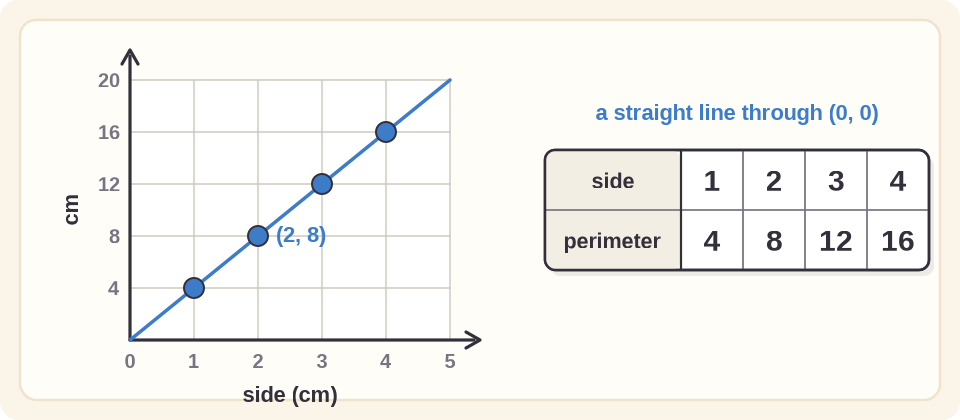
A line through zero means proportional
When two amounts are proportional, the pairs always lie on a straight line through (0, 0).
Now try the side and the area of a square: (1, 1), (2, 4), (3, 9), (4, 16). When the side doubles from 2 to 4, the area becomes 4 times as big.
These points bend upward. They are not on a straight line, so area is not proportional to the side.
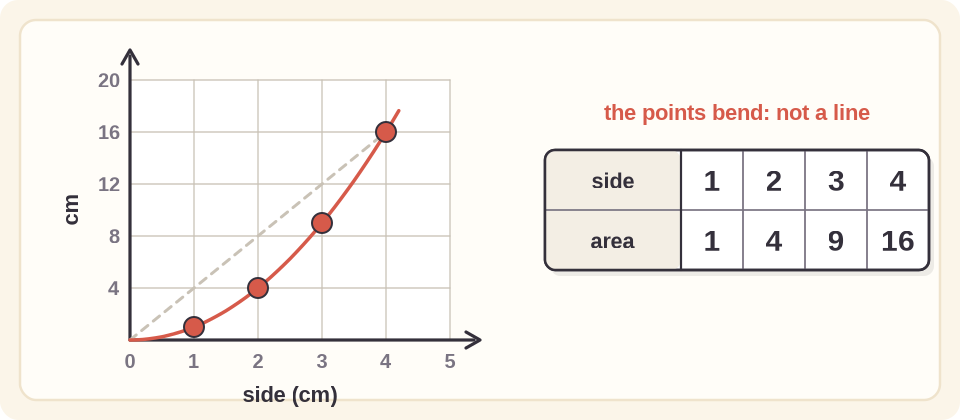
Try it at home
- Make a table of the number of bikes and their wheels for 1 to 5 bikes.
- Plot the pairs on squared paper.
- Do they lie on a straight line through (0, 0)?
Words in this lesson
- ordered pair - two numbers in order, (x, y): go right x, then up y.
- origin - the point (0, 0), where the two axes meet.
Big idea
The pairs of two proportional amounts lie on a straight line through (0, 0).