Factor Trees
Every whole number bigger than 1 is built by multiplying primes: 60 = 2 × 2 × 3 × 5. How do you find them?
Primes first
A prime number has exactly two factors, 1 and itself: 2, 3, 5, 7, 11, 13...
6 = 2 × 3 is not prime, so it can be split.
1 is not a prime, and it never goes in a factor tree: 1 × 15 splits nothing.
Grow a factor tree
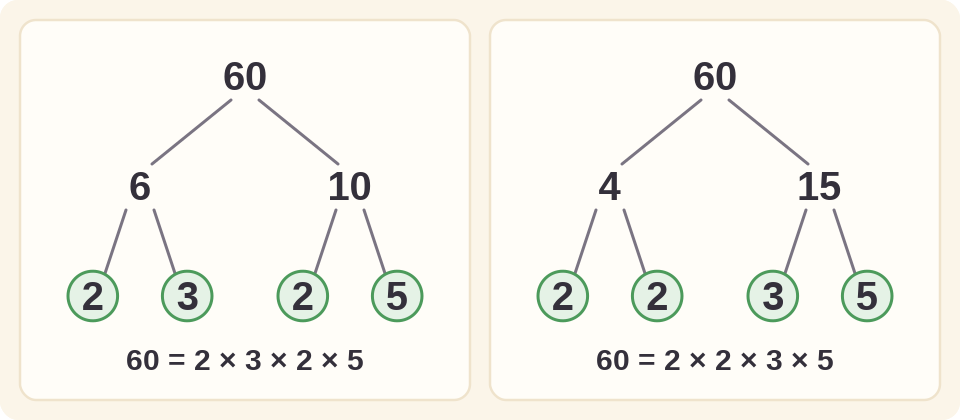
Write 60 at the top and split it: 60 = 6 × 10.
6 and 10 aren't prime, so split them: 2 × 3 and 2 × 5.
Every branch now ends in a prime. The ends give the prime factorization: 60 = 2 × 2 × 3 × 5.
Start with 4 × 15, and you reach the same primes.
Quick tests help
2 divides even numbers, and 5 numbers ending in 0 or 5.
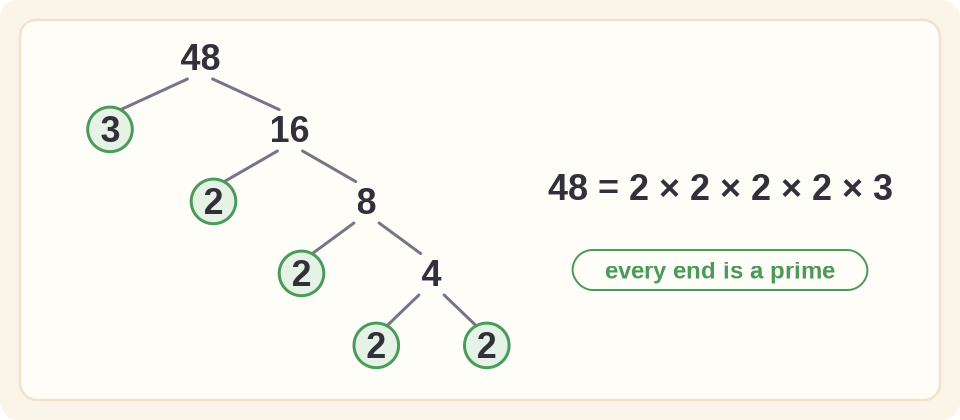
3 divides a number when it divides its digit sum: 4 + 8 = 12, so 3 divides 48. 9 works the same way.
48 = 3 × 16, and 16 splits into 2s: 48 = 2 × 2 × 2 × 2 × 3.
Careful
A tree isn't finished while an end can split. For 30, 2 × 15 isn't done: 15 = 3 × 5.
Try it at home
- Write 36 at the top of a sheet of paper.
- Split it until every end is a prime.
- Ask someone to start with other factors. Do you both reach 2 × 2 × 3 × 3?
Words in this lesson
- prime number - a number with exactly two factors, like 7.
- prime factorization - a number written as a product of primes.
Big idea
Split a number into factors until every branch ends in a prime: that is its prime factorization.