Exponents
Zara sends a joke to 3 friends. Each sends it to 3 more, and so on. The fourth round reaches 3 × 3 × 3 × 3 people. Is there a shorter way to write that?
Base and exponent
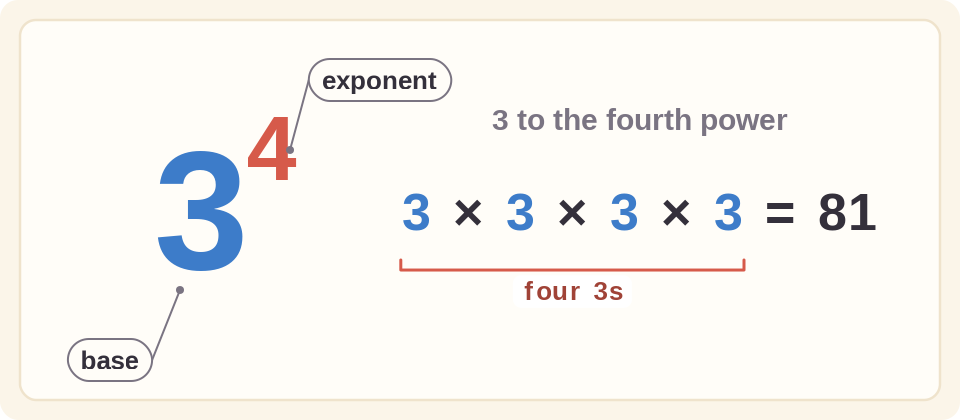
When the same number is multiplied again and again, write it as a power: 3 × 3 × 3 × 3 = 3⁴.
The big 3 is the base, the number being multiplied. The small raised 4 is the exponent: it counts how many 3s.
Say "3 to the fourth power." 3⁴ = 81 people.
3⁴ is not 3 × 4 = 12: the exponent counts copies.
Powers grow fast
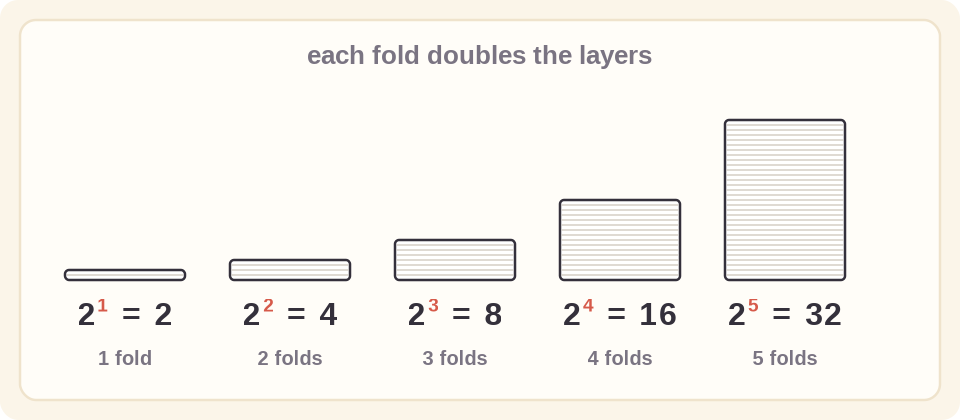
Fold a sheet of paper in half: 2 layers. Each fold doubles the layers again.
After 5 folds there are 2 × 2 × 2 × 2 × 2 = 2⁵ = 32 layers.
Adding 2 each time would give only 10.
Powers of ten
10² = 100, 10³ = 1,000, and 10⁶ = 1,000,000. The exponent of 10 is the number of zeros after the 1.
A number to the power 1 is just the number: 7¹ = 7.
Try it at home
- Fold a sheet of paper in half again and again.
- After each fold, write the number of layers as a power of 2.
- How many layers would 10 folds make? Use a calculator.
Words in this lesson
- power - a number multiplied by itself again and again, like 3⁴.
- base - the number that is multiplied in a power: 3 in 3⁴.
- exponent - the small raised number that counts how many times the base is multiplied.
Big idea
An exponent counts how many copies of the base are multiplied, so 2⁵ is 2 × 2 × 2 × 2 × 2 = 32.