Reflections on a Grid
Stand 2 steps in front of a mirror. Your image seems to stand 2 steps behind it. A grid works the same way.
Straight across, just as far
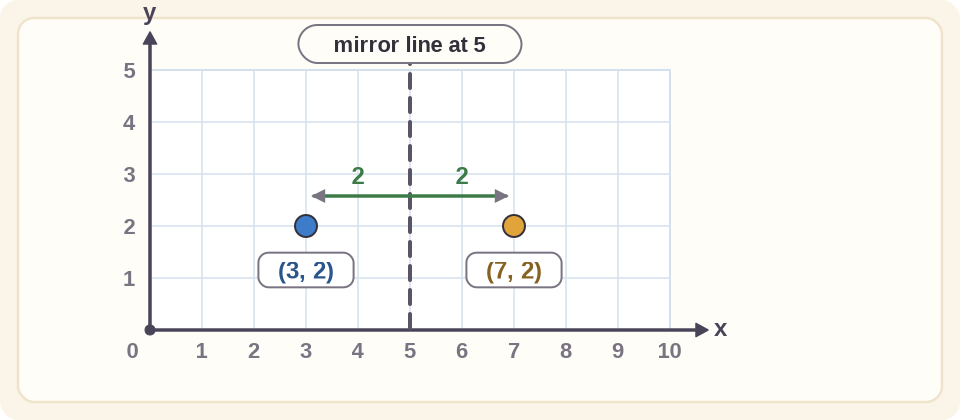
To reflect a point over a mirror line, go straight across the line and just as far on the other side.
The dashed line stands at 5 on the x-axis. (3, 2) is 2 units to its left, so its image is 2 units to its right, at 7.
It doesn't move up or down, so the second number stays 2: the image is (7, 2).
A lying mirror line
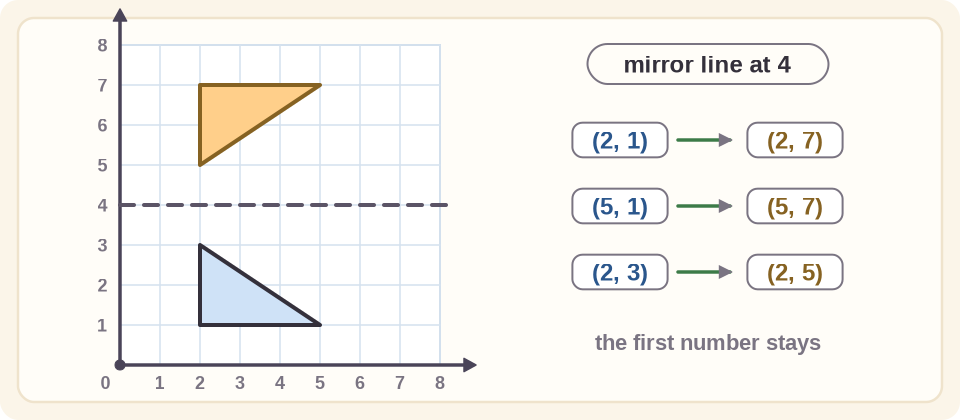
If the mirror line lies flat at 4 on the y-axis, the first number stays.
(2, 1) is 3 below the line, so its image is 3 above it: (2, 7).
To reflect a shape, reflect each corner and join them. The image faces the other way.
Corners tell you more
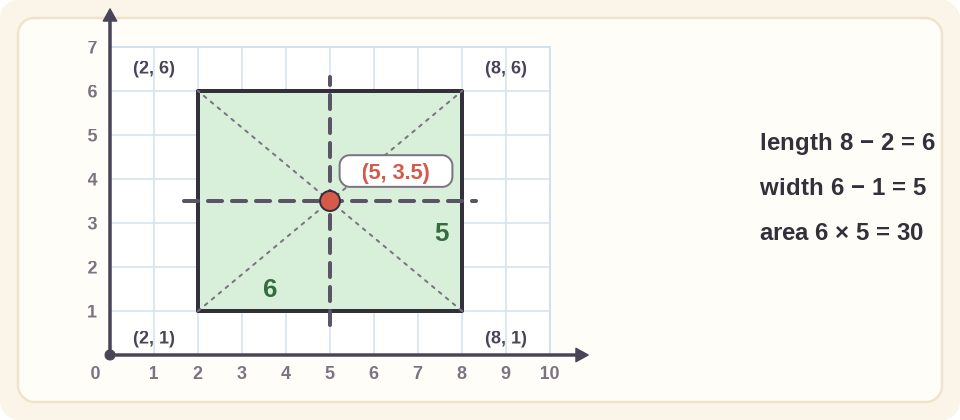
A rectangle has corners (2, 1), (8, 1), (8, 6) and (2, 6). It is 8 − 2 = 6 long and 6 − 1 = 5 wide, so its area is 6 × 5 = 30 square units.
Its two mirror lines are halfway across, at 5, and halfway up, at 3.5. Coordinates can be decimals!
They cross at its center, (5, 3.5), where its diagonals cross too.
Try it at home
- On grid paper, draw a dashed line up through 5 on the x-axis.
- Plot the triangle (1, 3), (2, 6), (4, 4).
- Reflect each corner over the line and join the images.
Words in this lesson
- mirror line - the line a shape is flipped over.
- image - where a point or shape lands after a move.
Big idea
To reflect over a grid line, keep one coordinate and send the other just as far to the other side of the line.