Quartiles
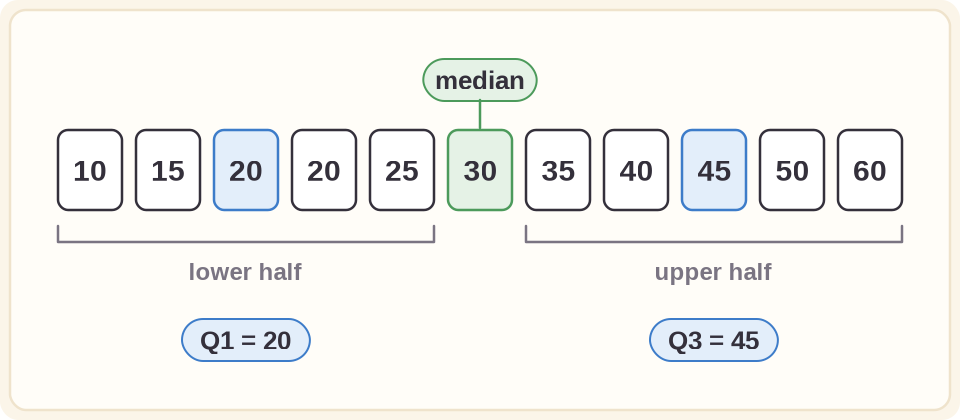
Eleven students exercised for 10, 15, 20, 20, 25, 30, 35, 40, 45, 50 and 60 minutes yesterday. The median cuts the data in half. What if you cut each half again?
Cut the data into four
The median is the middle value, the 6th: 30 minutes.
Leave it out. The lower half is 10, 15, 20, 20, 25; the upper half is 35, 40, 45, 50, 60.
The median of the lower half, 20, is the first quartile, or Q1.
The median of the upper half, 45, is the third quartile, or Q3.
Q1, the median and Q3 cut the data into four parts of about the same size.
The five-number summary
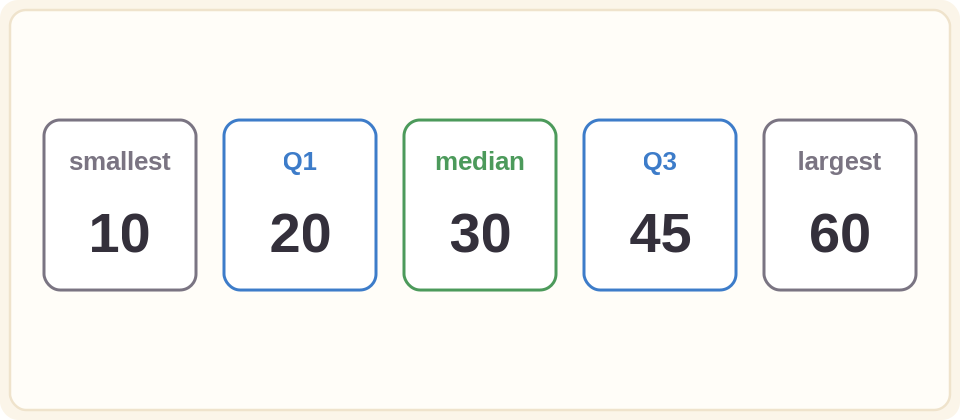
The smallest value, Q1, the median, Q3 and the largest value describe the data in short.
Here they are 10, 20, 30, 45 and 60. This is the five-number summary.
An even number of values
With 8 values, 2, 4, 5, 7, 8, 9, 11, 12, the median is (7 + 8) ÷ 2 = 7.5. Each half has 4 values: 2, 4, 5, 7 and 8, 9, 11, 12.
Q1 is (4 + 5) ÷ 2 = 4.5, and Q3 is (9 + 11) ÷ 2 = 10.
Try it at home
- Write down the ages of 7 people you know, in order.
- Find the median, Q1 and Q3, and write the five-number summary.
Words in this lesson
- quartiles - the three values that cut ordered data into four parts: Q1, the median and Q3.
- first quartile (Q1) - the median of the lower half.
- third quartile (Q3) - the median of the upper half.
- five-number summary - the smallest value, Q1, the median, Q3 and the largest value.
Big idea
Q1 and Q3 are the medians of the lower and upper halves; with the median, they cut the data into four parts.