Volume with Fraction Edges
A fish tank for a small turtle is 2 ft long, ft wide and 1 ft tall. Its edges aren't whole numbers. Does length × width × height still work?
Counting and the rule agree
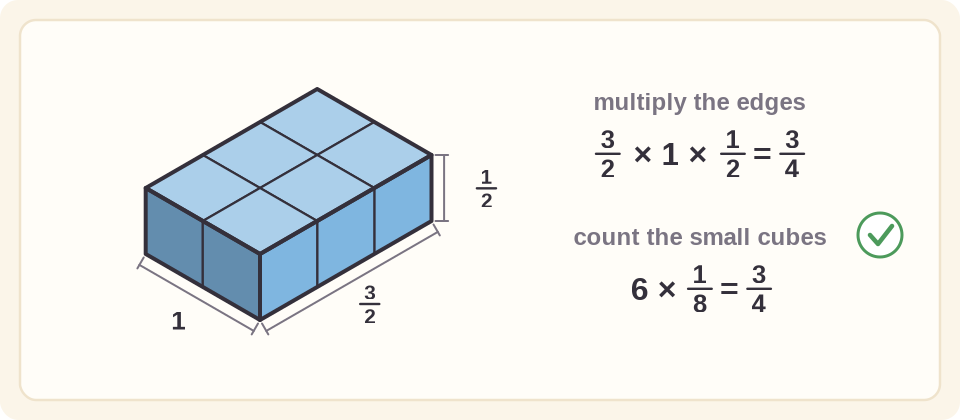
Pack a box cm by 1 cm by cm with cubes of edge cm. It holds 3 × 2 × 1 = 6 of them, each cm³: a volume of = cm³.
Now multiply the edges: × 1 × = . The same!
Multiplying the edges counts all the eighths at once. So V = l × w × h works with fractions too.
The turtle's tank
V = 2 × × 1 = 3 cubic feet.
A sandbox m long, 2 m wide and m deep holds × 2 × = = m³ of sand.
Adding the edges gives no volume. Multiply.
Base times height
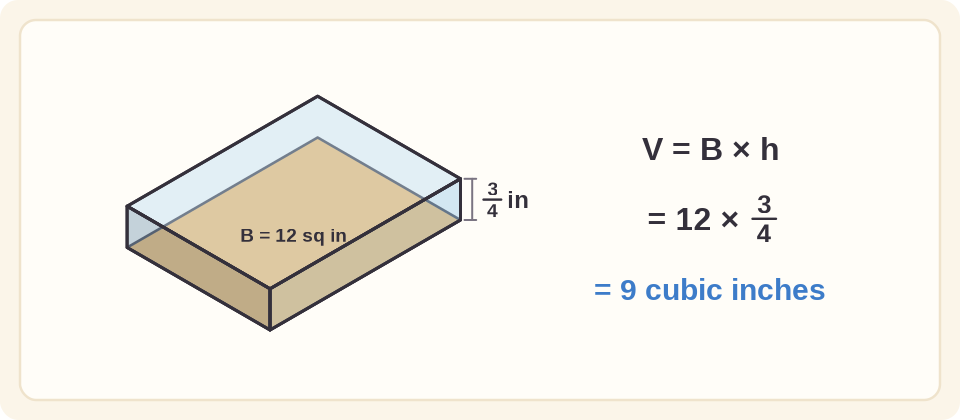
The bottom of a box is its base; its area is B.
A box whose base is 12 square inches and whose height is in: V = B × h = 12 × = 9 cubic inches.
Try it at home
- Find a box at home and measure its edges to the nearest half inch.
- Multiply length × width × height.
- Work out the area of its bottom, then multiply by the height. Do you get the same?
Words in this lesson
- volume - how much space a solid takes up, in cubic units.
- base (of a box) - the face it stands on; B is that face's area.
Big idea
V = l × w × h = B × h works for fraction edges too, and gives the same answer as packing small cubes.