Nets
Take a cereal box apart along some of its edges and lay it flat. The flat shape you get is called a net. Fold it back up and it is the box again.
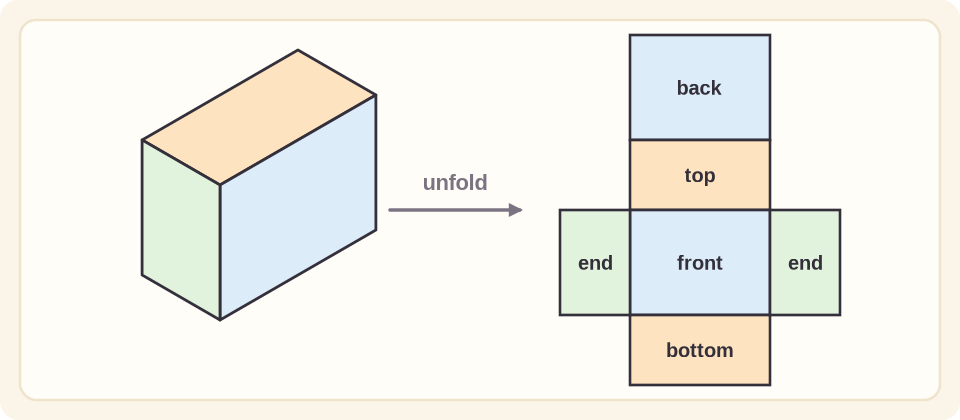
A box's net
A box has 6 faces: a top and a bottom, a front and a back, and two ends. Its net shows all 6, joined edge to edge.
Which nets make a cube?
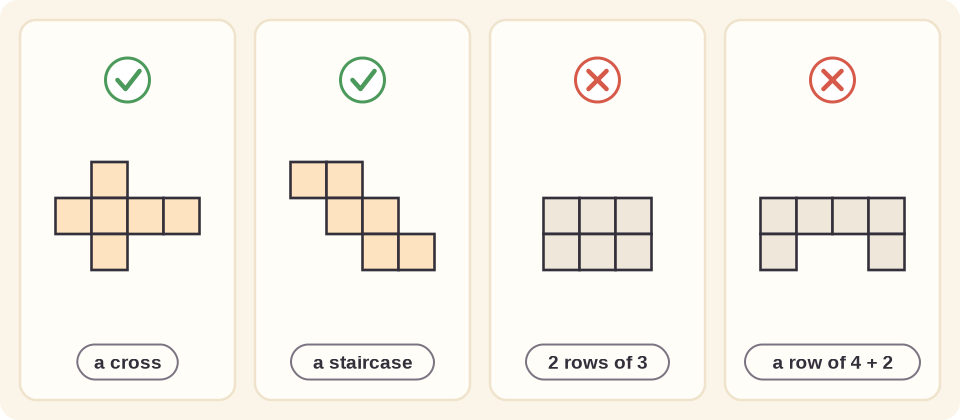
A cube's net is six squares. Not every six squares will fold into a cube.
A cross folds up. So does a staircase of squares, two by two going down. But a block of two rows of three can't close, and a row of four with a square under each end puts two faces on top of each other.
In a cube's net, squares with one square between them in a row end up opposite each other.
Pyramids, prisms and cans
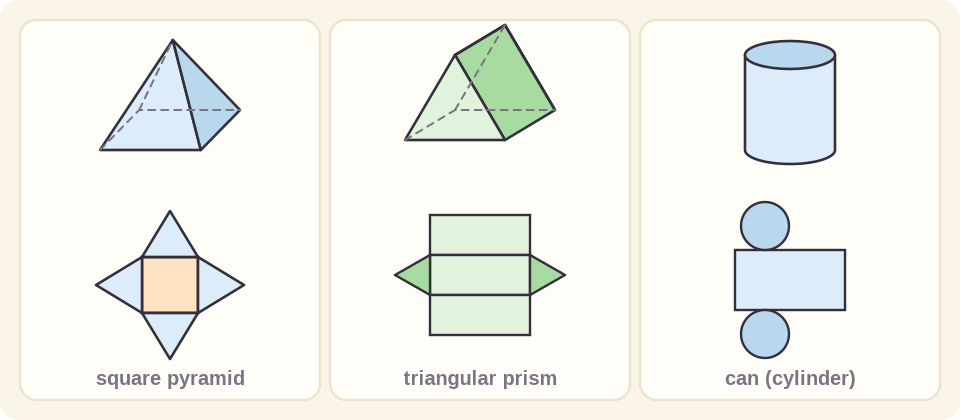
A pyramid with a square bottom has a net of a square with a triangle on each side. The triangles fold up and meet at the top.
A triangular prism unfolds into 3 rectangles and 2 triangles.
A can (a cylinder) unfolds into a rectangle and two circles.
Try it at home
- Open a small box (tea, toothpaste) carefully along its glued edges.
- Lay it flat and count the faces of its net.
- Draw six squares in a cross, cut them out and fold them into a cube.
Words in this lesson
- net - a flat shape that folds up into a solid, showing all its faces.
- face - a flat surface of a solid.
- opposite faces - two faces of a solid that face away from each other, like a box's top and bottom.
Big idea
A net is a solid unfolded flat: every face, joined edge to edge.