GCF Word Problems
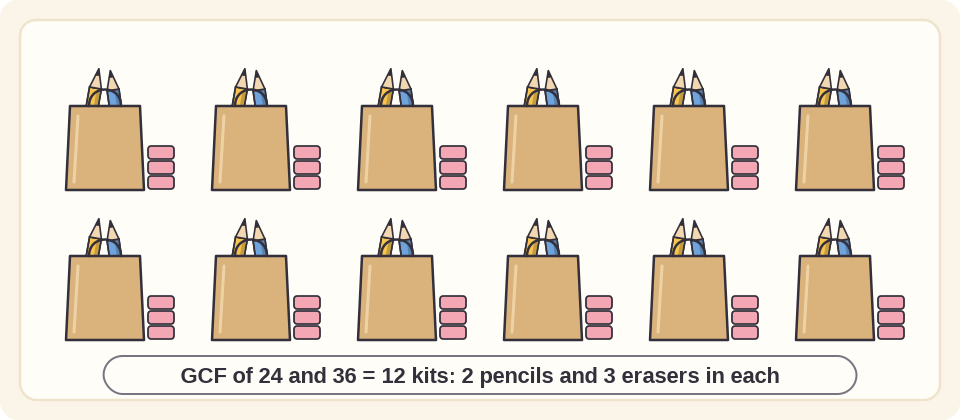
Priya has 24 pencils and 36 erasers for art kits. Every kit must be the same, with nothing left over. How many kits can she make, at most?
The most equal groups
The number of kits must divide 24 and divide 36. So it is a common factor of 24 and 36.
The common factors are 1, 2, 3, 4, 6 and 12. The most is the GCF: 12 kits.
Each kit gets 24 ÷ 12 = 2 pencils and 36 ÷ 12 = 3 erasers.
8 kits won't work: 36 ÷ 8 leaves 4 erasers over.
The biggest equal pieces
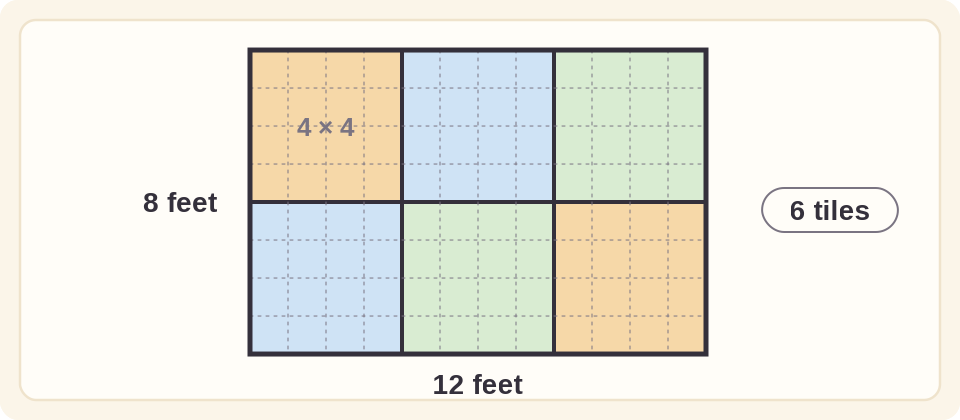
A floor is 12 feet long and 8 feet wide. Square tiles, all the same size, must cover it with none cut.
A tile's side must fit along 12 and along 8 exactly. So it is a common factor of 12 and 8: 1, 2 or 4.
The biggest tile is 4 feet by 4 feet. It takes 3 × 2 = 6 tiles.
A 3-foot tile fits along 12, but not along 8.
Clues in the question
"The most groups", "the biggest size", "all the same, none left over": these ask for the GCF.
The answer is never bigger than the smaller of the two numbers.
Try it at home
- Count out 12 spoons and 18 forks, or two other things you have many of.
- Share them into as many equal sets as you can, with none left over.
- How many sets did you make? Is it the GCF of 12 and 18?
Words in this lesson
- greatest common factor (GCF) - the biggest number that divides two numbers, like 12 for 24 and 36.
Big idea
When a story asks for the most equal groups or the biggest equal pieces, find the GCF.