Statistical Questions
"How old am I?" has one answer. "How old are the students in my school?" has many. Only the second one needs statistics.
One answer or many?
A statistical question is a question you answer by collecting many answers that are not all the same.
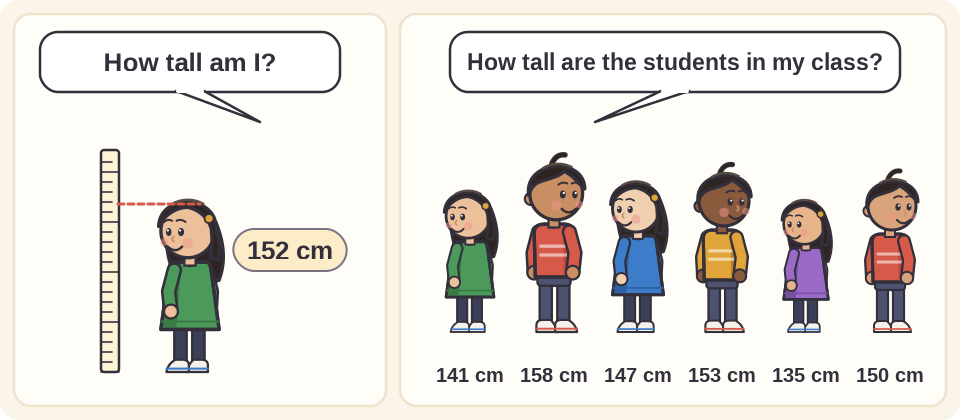
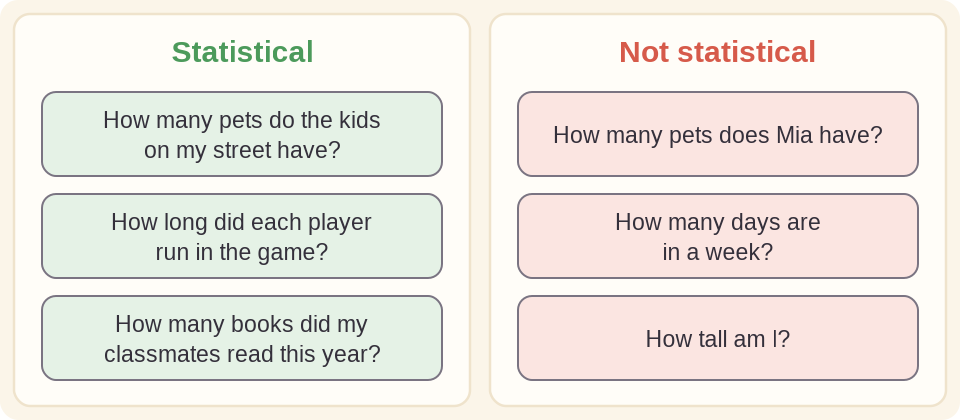
"How tall am I?" is not a statistical question: you measure once, and you have the answer.
"How tall are the students in my class?" is one. Every student gives a different number, and you need all of them to answer.
Expect the answers to vary
The answers to a statistical question vary: they are spread out over different values. That is what makes the question interesting.
"How many pets does Mia have?" has one answer. "How many pets do the kids on my street have?" has an answer for each kid: 0, 2, 1, 1, 3...
"How many days are in a week?" is not statistical either. Everyone who answers gives the same answer, 7.
From a question to data
The answers you collect are called data. To answer "How long do my classmates read at night?", you ask each one and write down the minutes: 20, 15, 30, 20, 45...
A list like this is hard to read. The next lessons show how to draw it so its whole shape shows at once.
Try it at home
- Write one question about your family that has only one answer.
- Change it into a statistical question: ask it about every person in your family.
- Collect the answers. Are they all the same?
Words in this lesson
- statistical question - a question answered by collecting data that you expect to vary.
- data - the answers or measurements you collect.
- vary - to be different from one another.
Big idea
A statistical question expects many different answers; the answers are the data.