The Mean as a Balance Point
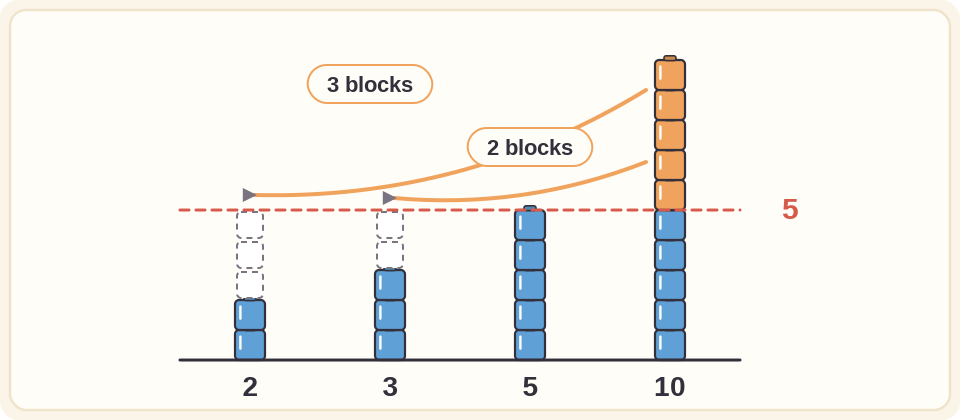
Four friends scored 2, 3, 5 and 10 goals this season. If they shared the goals fairly, how many would each have?
A fair share
Put the goals together: 2 + 3 + 5 + 10 = 20. Share them: 20 ÷ 4 = 5.
This fair share is the mean: add the values and divide by how many values there are.
Towers show it too: move blocks from tall to short until all four are 5 high.
Where a dot plot balances
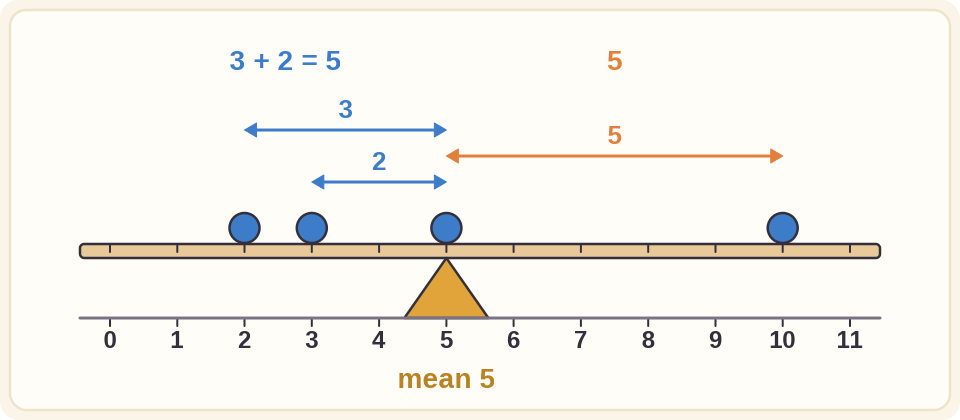
Now put the values on a dot plot: a board with a weight at each dot.
The board balances on a point under the mean, 5.
The dots below 5 are 3 and 2 away from it: 3 + 2 = 5. The dot above it is 5 away. The distances on the two sides add up to the same.
Every mean is the balance point of its data.
One far value moves it
The 10 is far from the others and pulls the balance point toward it. Without it, the mean of 2, 3 and 5 is 10 ÷ 3, just over 3.
Scientists measure several times and use the mean, since one try can be a little off. But a try far from the rest, like 31 after 10 and 10, is probably a mistake: measure again.
Try it at home
- Tape coins on a ruler at 2, 3, 5 and 10 cm.
- Balance the ruler on your finger. Is your finger near 5?
Words in this lesson
- mean - the sum of the values divided by how many there are.
- balance point - the place a board with the data on it would balance: the mean.
Big idea
The mean is the fair share and the balance point: the distances to it on each side add up to the same.