Dividing Decimals the Standard Way
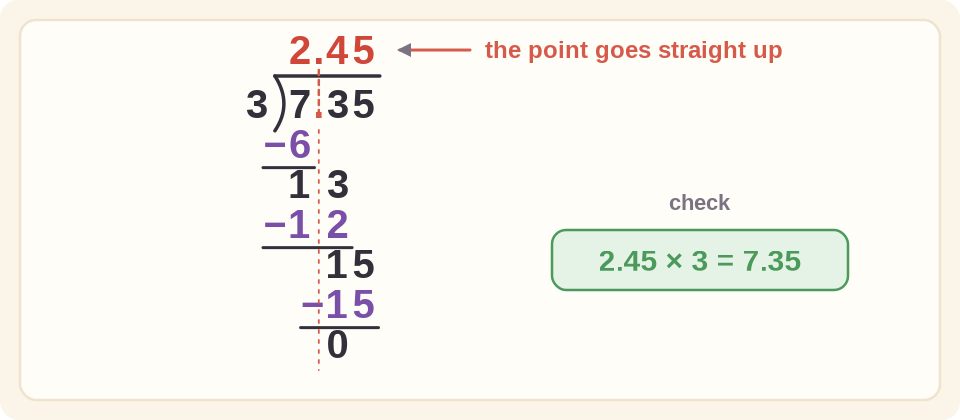
Three friends split a bill of 7.35 dollars equally. How much does each one pay?
The point goes straight up
Divide as with whole numbers: 7 ÷ 3 = 2, 13 ÷ 3 = 4, 15 ÷ 3 = 5.
Put the quotient's point straight above the dividend's point: 7.35 ÷ 3 = 2.45.
Each pays 2.45 dollars. Check by multiplying: 2.45 × 3 = 7.35.
A decimal remainder
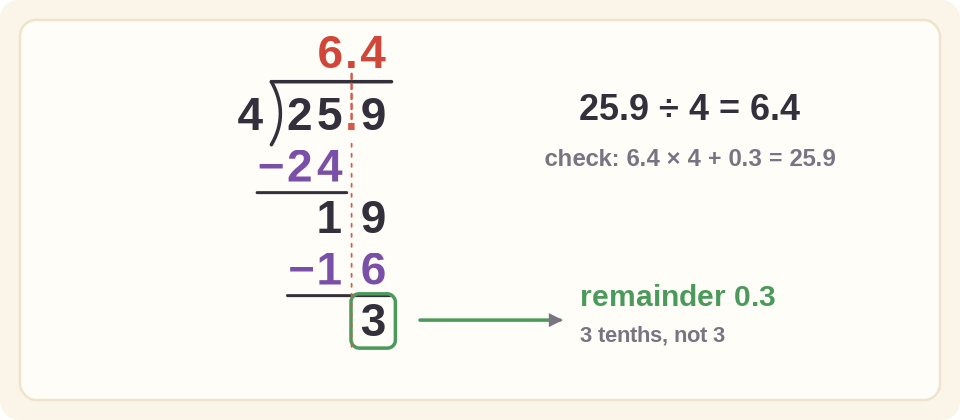
25.9 ÷ 4: 25 ÷ 4 = 6, with 1 left. 19 tenths ÷ 4 = 4 tenths, with 3 tenths left.
So 25.9 ÷ 4 = 6.4, remainder 0.3. The 3 sits in the tenths, so it is 0.3, not 3.
To go on, write a 0 after the 9 and keep dividing: 25.90 ÷ 4 = 6.475 in the end.
A fraction as a decimal
means 7 ÷ 8. Write 7 as 7.000 and divide: 0.875.
To two decimal places, stop at the hundredths: is 0.87, with a little left over.
By 100, or by a decimal
÷ 100 moves every digit 2 places right: 36.5 ÷ 100 = 0.365.
Dividing by a decimal asks how many times it fits: 1.5 ÷ 0.3 = 5, since 5 jumps of 0.3 reach 1.5. Check: 5 × 0.3 = 1.5.
Try it at home
- Look at a store receipt for something bought in a pack of 2, 3 or 4.
- Divide the price by the number in the pack.
- Check by multiplying the answer back.
Words in this lesson
- dividend - the number being divided.
- remainder - what is left at the end of a division; in a decimal division it is a decimal too.
Big idea
Divide a decimal by a whole number as with whole numbers, putting the quotient's point straight above the dividend's.