Adding and Subtracting Decimals the Standard Way
Mia ran 4.25 km on Saturday and 3.7 km on Sunday. How far did she run in all?
Line up the points
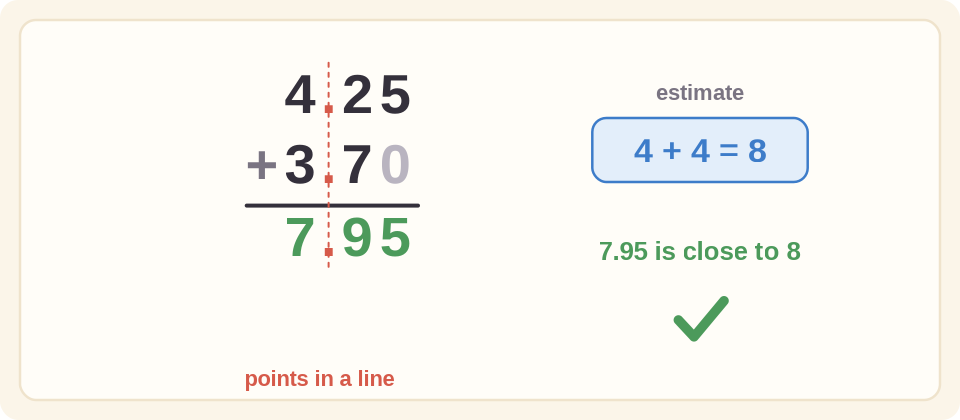
Write the numbers in a column with the points under each other. Then tenths are under tenths and hundredths under hundredths.
3.7 has no hundredths, so write a 0 there: 3.70. It is the same number.
Add from the right like whole numbers, and bring the point straight down: 4.25 + 3.70 = 7.95.
Estimate to check
Round each number to the nearest whole: 4 + 4 = 8. 7.95 is close to 8, so it makes sense.
A classmate adds 5.6 + 3.48 and gets 40.4. Drop the decimal digits: 5 + 3 = 8. So 40.4 is far too big: the points weren't lined up.
Subtract with zeros
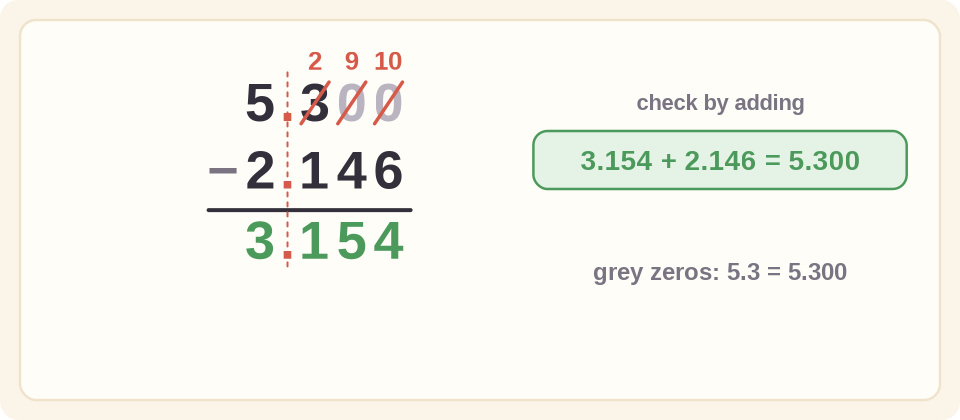
5.3 − 2.146: write 5.3 as 5.300, so both have thousandths.
Subtract from the right, regrouping as with whole numbers: 5.300 − 2.146 = 3.154.
Check by adding: 3.154 + 2.146 = 5.300.
One place at a time
In your head, add one place at a time: 2.36 + 1.42 is 2.36 + 1 = 3.36, then + 0.4 = 3.76, then + 0.02 = 3.78.
Try it at home
- Find two receipts or price tags.
- Add the two prices in a column, points lined up.
- Estimate first, then check your answer is close.
Words in this lesson
- decimal point - the dot that separates the whole number from the tenths, hundredths and so on.
- estimate - a number close to the answer, found with easier numbers.
Big idea
Line up the points, fill empty places with zeros, then add or subtract from the right and estimate to check.