Cubes with Fraction Edges
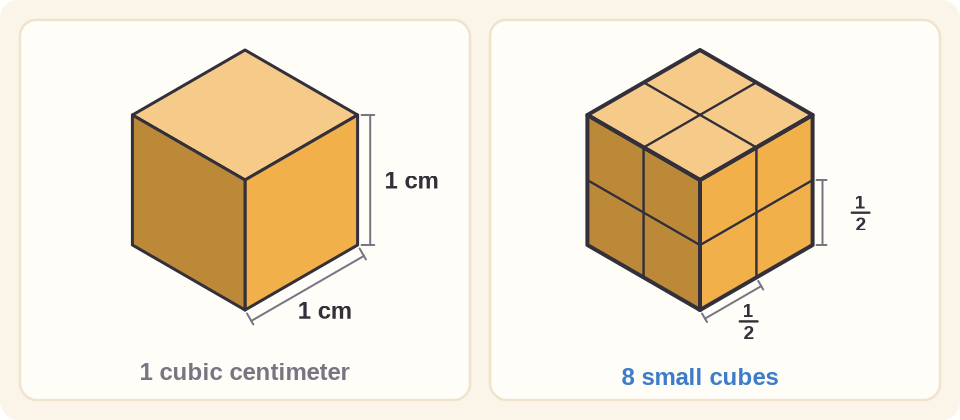
A cube with edges of 1 cm has a volume of 1 cubic centimeter. What about a tiny cube with edges of cm? Is its volume cubic centimeter too?
Eight small cubes in one
Cut a 1 cm cube in half along its length, its width and its height. You get 2 × 2 × 2 = 8 small cubes, each with edges of cm.
Eight of them make 1 cubic centimeter, so each one is of a cubic centimeter, not .
With the rule: × × = .
Pack a box
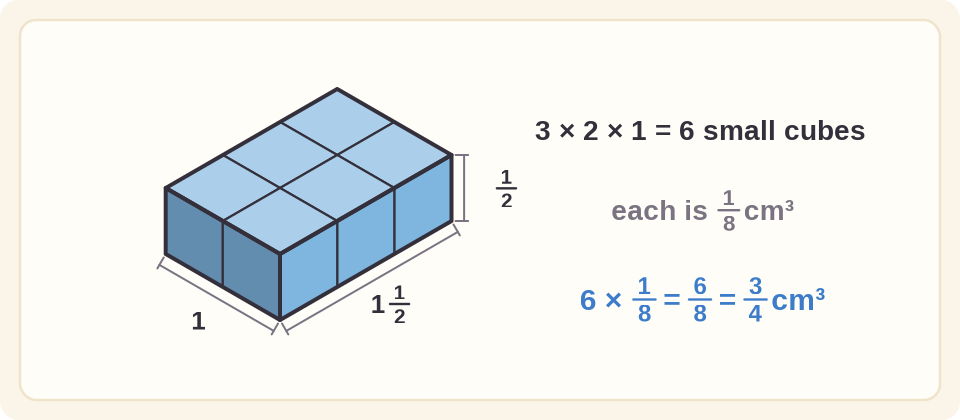
A box is cm long, 1 cm wide and cm high. Fill it with cm cubes.
Along the length fit 3, along the width 2, and up the height 1. That is 3 × 2 × 1 = 6 small cubes.
6 eighths of a cubic centimeter is = cm³.
Thirds too
A cube with edges of cm: 3 × 3 × 3 = 27 of them fill a 1 cm cube, so each one is cm³.
A box packed with 16 of the cm cubes has a volume of 16 eighths: 2 cm³.
Try it at home
- Find 8 sugar cubes or dice the same size.
- Build one big cube, 2 along each edge.
- If the big cube were 1 unit on each edge, what part of it would one small cube be?
Words in this lesson
- cubic unit - the volume of a cube 1 unit on each edge.
- edge - a line where two faces of a solid meet.
Big idea
A cube with edges of one half is one eighth of a cubic unit: eight of them fill a unit cube.