Writing Inequalities for Stories
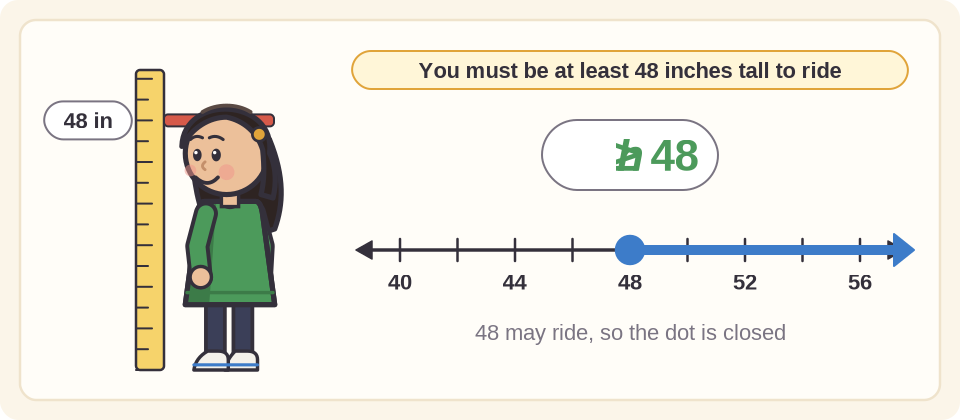
A sign at a roller coaster says: you must be at least 48 inches tall to ride. Which heights may ride?
At least and at most
Let be a rider's height in inches. "At least 48" means 48 or more, so .
A rider who is exactly 48 inches tall may ride, so the dot at 48 is closed.
Words and signs
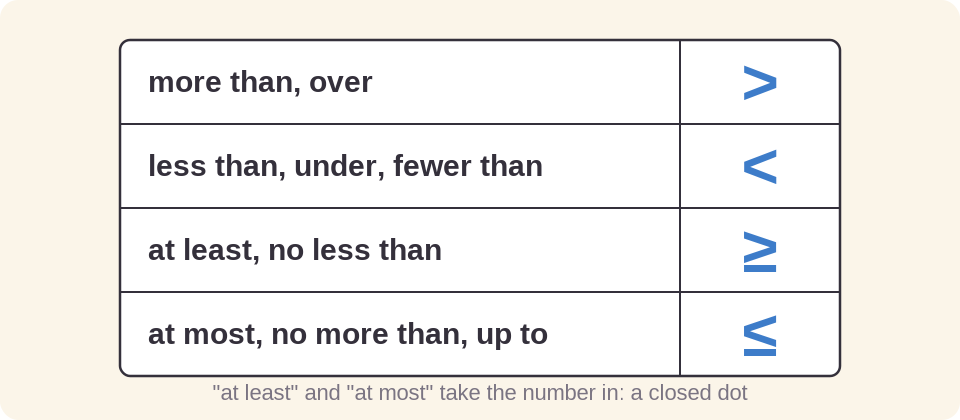
"More than" and "over" are >. "Less than", "under" and "fewer than" are <.
"At least" and "no less than" are ≥. "At most", "no more than" and "up to" are ≤.
A bus holds no more than 40 students: . Children under 12 get in free: .
Does it make sense?
Sometimes only some solutions fit the story. In , counts students, so it can be 0, 1, 2 and so on up to 40, but never 12.5 or a negative number.
Try it at home
- Find a sign with a limit on it: a speed limit, a weight limit in an elevator, an age on a game box.
- Choose a letter and write the limit as an inequality.
- Draw it on a number line. Is the dot open or closed?
Words in this lesson
- at least - that number or more: ≥.
- at most - that number or less: ≤.
Big idea
"At least" is ≥ and "at most" is ≤; take the letter, the sign and the number from the story.