Mean or Median?
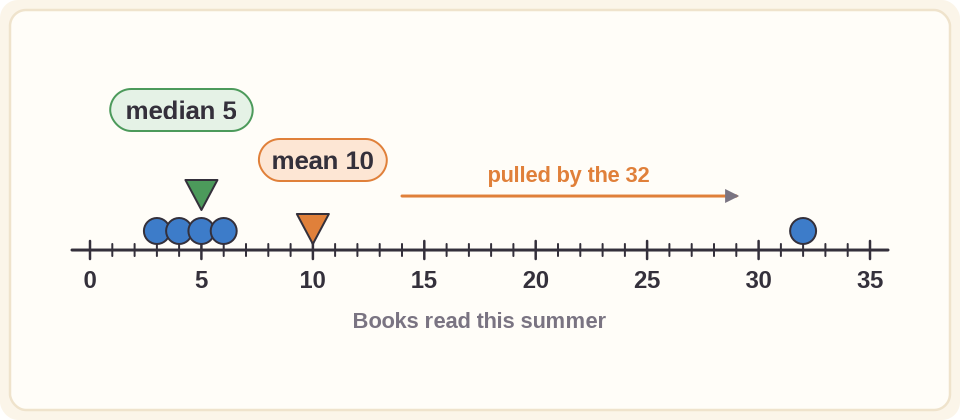
Five friends counted the books they read this summer: 3, 4, 5, 6 and 32. The friend with 32 loves books! How many books does a typical friend read?
Two centers
The mean: 3 + 4 + 5 + 6 + 32 = 50, and 50 ÷ 5 = 10 books.
The median: the values are in order already, and the middle one is 5 books.
Which one describes the group better? Four of the five friends read 6 books or fewer. Nobody read anything close to 10.
Outliers pull the mean
The outlier, 32, pulls the mean toward it. The mean is the balance point, so one heavy far value moves it a lot.
The median hardly moves. If the 32 were 100, the median would still be 5, but the mean would be 23.6.
So when the data have an outlier, or are skewed, the median describes a typical value better.
When the mean is better
When the data are close to symmetric and have no outliers, the mean and the median are close together.
Then the mean is a good choice, since it uses every value. The times of 2, 3, 3, 4 and 5 minutes have a mean of 3.4 and a median of 3.
Try it at home
- Write down the ages of 5 people in your family.
- Find the mean and the median.
- Which is a better way to say how old a typical person in your family is? Why?
Words in this lesson
- typical - like most of the others; what you would expect.
Big idea
An outlier pulls the mean but hardly moves the median, so use the median for data with outliers or a long tail.