Reciprocals
What number times makes exactly 1?
Flip the fraction
Try : × = = 1. It works!
Two numbers that multiply to 1 are reciprocals. To find one, swap the numerator and the denominator.
The reciprocal of is . Check: × = = 1.
A picture of it
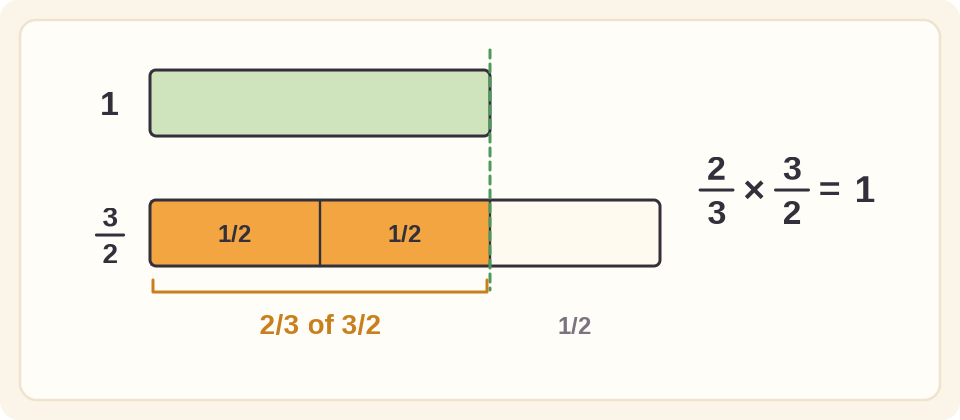
of a strip is a strip and a half. Cut it into 3 equal parts: each is half a strip.
of it is 2 of those parts: two halves, exactly one whole strip.
Whole numbers, mixed numbers, decimals
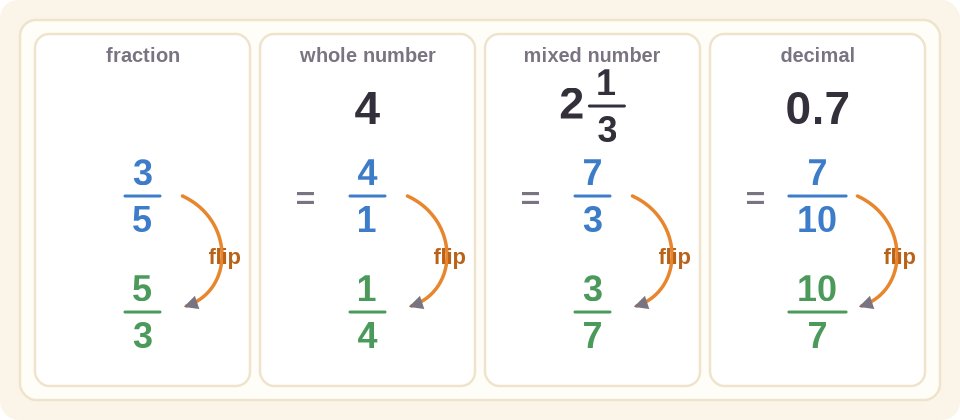
Write each one as a fraction first. 4 is , so its reciprocal is .
is , so its reciprocal is .
0.7 is , so its reciprocal is .
1 is its own reciprocal: 1 × 1 = 1.
Zero has none
0 times any number is 0, never 1. So 0 has no reciprocal.
Careful
Change a mixed number to a fraction before you flip it: the reciprocal of is , not 2 and 3 over 1.
Try it at home
- Write 5 fractions on cards and their reciprocals on other cards.
- Mix them up and match each pair.
- Check each pair by multiplying. Do you always get 1?
Words in this lesson
- reciprocal - the number you multiply by to get 1; for a fraction, the fraction flipped.
Big idea
A number and its reciprocal multiply to 1: flip a fraction to find it, and remember 0 has none.