Experimental Probability
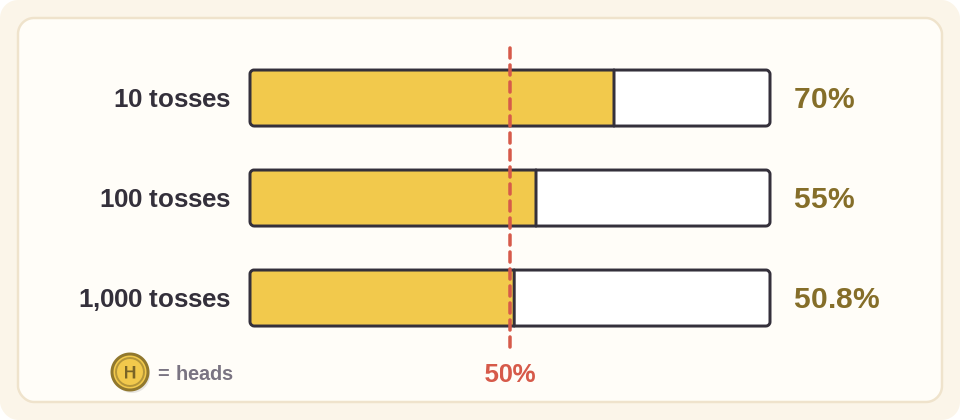
Ana tossed a coin 10 times and got 7 heads. "Heads is more likely!" she said. Is she right? A coin should land heads half the time.
Probability from trying
Each toss is a trial. What happened, out of all the trials, is the experimental probability.
Ana got heads in 7 of 10 trials: = 0.7, or 70%.
That is far from 0.5. But 10 tosses are very few. A small number of trials can easily come out lopsided.
More trials, closer to the truth
Ana's class tossed coins 100 times: 55 heads, 55%. Then 1,000 times: 508 heads.
508 of 1,000 is . Divide the top and the bottom by 10: 50.8 of every 100, or 50.8%.
That is very close to 50%. With many trials, the experimental probability comes close to the theoretical one. It still almost never lands exactly on it.
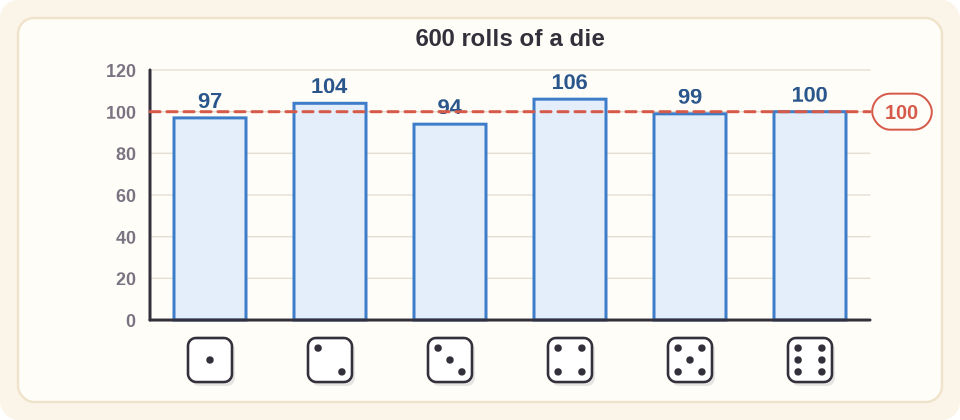
600 rolls of a die
A die was rolled 600 times. Each number should come about 600 ÷ 6 = 100 times.
The counts were all near 100, from 94 to 106. The bars are almost the same height, but not exactly.
Try it at home
- Toss a coin 20 times and count the heads. Write it as a fraction of 20 and as a percent.
- Add your results to a friend's or a family member's 20 tosses.
- Is the percent for 40 tosses closer to 50%?
Words in this lesson
- trial - one try of an experiment, like one toss of a coin.
- experimental probability - the number of times an event happened, out of the number of trials.
Big idea
Experimental probability comes from trials; the more trials there are, the closer it usually comes to the theoretical probability.