Area of Any Triangle
Not every triangle has a square corner. Is there one rule for the area of every triangle?
Two copies make a parallelogram
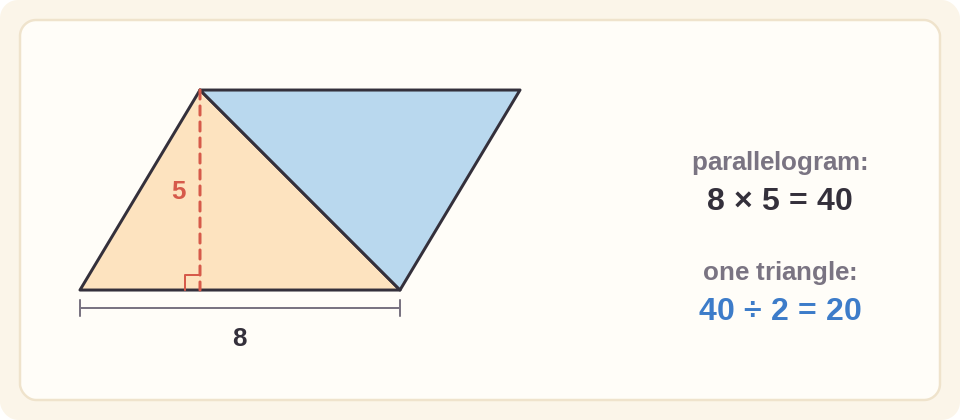
Take any triangle and a copy of it. Turn the copy upside down and put it next to the first.
Together they make a parallelogram with the same base and the same height as the triangle.
The parallelogram's area is base × height, so one triangle is half of that: A = × b × h.
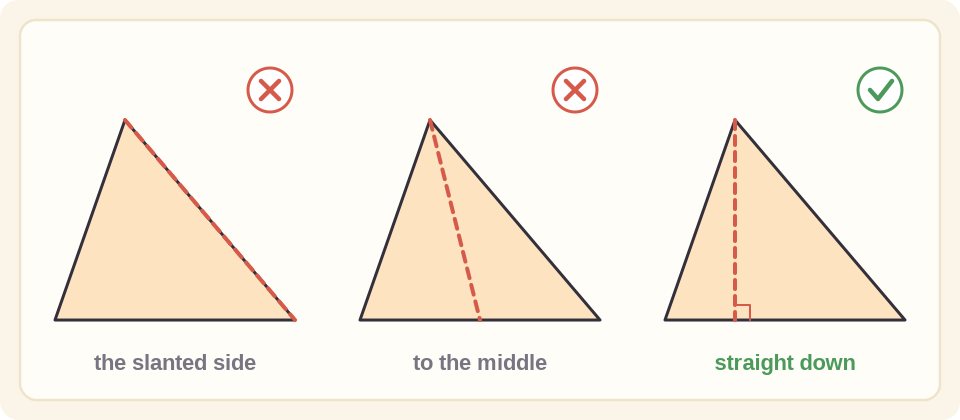
Which line is the height?
The height starts at the corner across from the base and goes straight down to the base, meeting it at a right angle.
It is not the slanted side, and it doesn't have to go to the middle of the base.
For a triangle with base 8 cm and height 5 cm: × 8 × 5 = 20 cm².
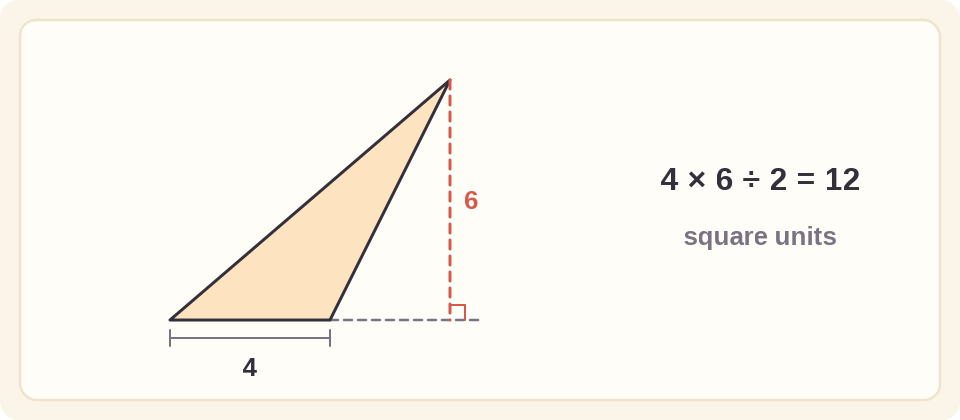
A height outside the triangle
In a triangle with a wide, blunt corner, the height can fall outside. Make the base line longer and measure straight down to it.
Base 4, height 6: × 4 × 6 = 12 square units, the same as any triangle with that base and height.
Try it at home
- Draw a triangle on paper and cut out two copies.
- Fit them together into a parallelogram.
- Measure its base and height. Half of base × height is one triangle's area.
Words in this lesson
- height of a triangle - the distance from a corner straight down to the opposite side (or that side's line), at a right angle.
Big idea
Every triangle is half of a parallelogram with the same base and height: A = one half × b × h.