Parts of an Expression
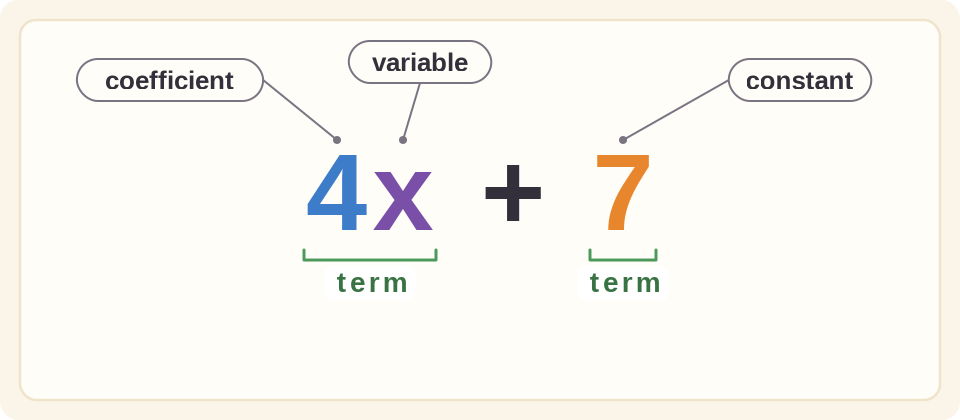
A teacher writes 4x + 7 on the board and asks, "How many terms does it have, and which number is the coefficient?" Expressions have parts, and each part has a name.
Terms
The parts of an expression that are added or subtracted are its terms. 4x + 7 has two terms: 4x and 7.
2a + 3b − 9 has three terms: 2a, 3b and 9.
Coefficients and constants
The number multiplying a variable is its coefficient. In 4x, the coefficient is 4.
A term with no letter is a constant: its value never changes. In 4x + 7, the constant is 7.
A letter on its own has coefficient 1, since x is 1x.
Factors
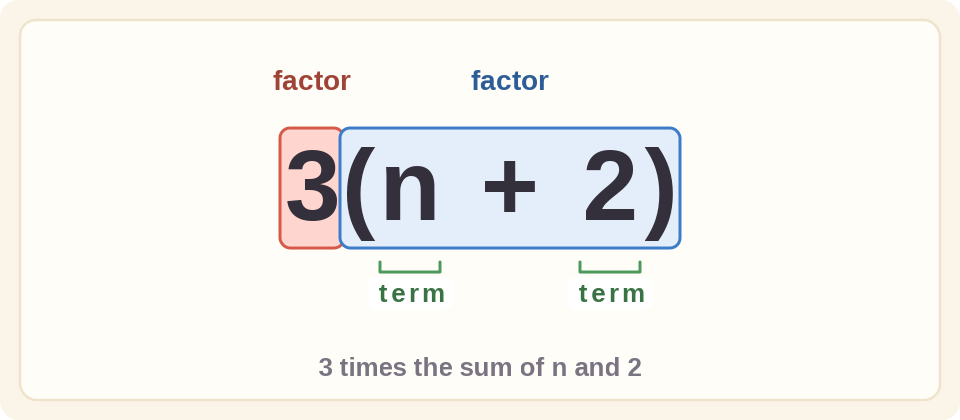
3(n + 2) is one term: the product of two factors, 3 and (n + 2).
The factor (n + 2) is itself a sum of two terms, n and 2. You can describe it without working it out: "3 times the sum of n and 2."
Try it at home
- Write the expression 5y + 2z + 8 on paper.
- Circle each term in a different color.
- Underline the coefficients and box the constant.
Words in this lesson
- term - a part of an expression that is added or subtracted, like 4x or 7.
- coefficient - the number that multiplies a variable: 4 in 4x.
- constant - a term with no variable, like 7.
Big idea
An expression is made of terms; a term with a letter has a coefficient, and a term with no letter is a constant.