The Language of Ratios
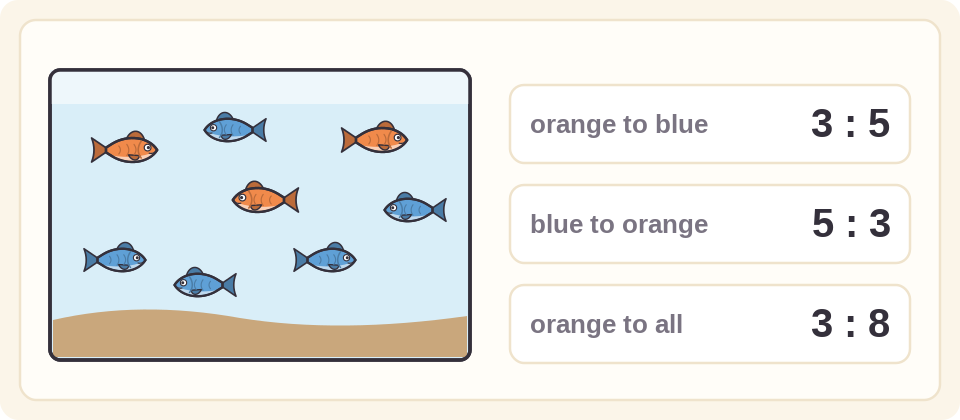
In a fish tank there are 3 orange fish and 5 blue fish. There are many ways to compare them, and each one is a ratio.
Ways to say a ratio
A ratio compares two amounts. The ratio of orange fish to blue fish is 3 to 5.
You can write it as 3 to 5, as 3:5, or like a fraction, . In words: for every 3 orange fish, 5 blue fish.
The amount named first goes first. Blue to orange is 5 to 3, a different ratio.
Part to part, part to whole
Orange to blue compares one part with another part: part to part.
There are 3 + 5 = 8 fish in all. Orange to all the fish is 3 to 8: part to whole. It is the fraction of the fish that are orange.
A class has 12 girls and 13 boys. Girls to boys is 12 to 13, but girls to all the children is 12 to 25.
The same unit first
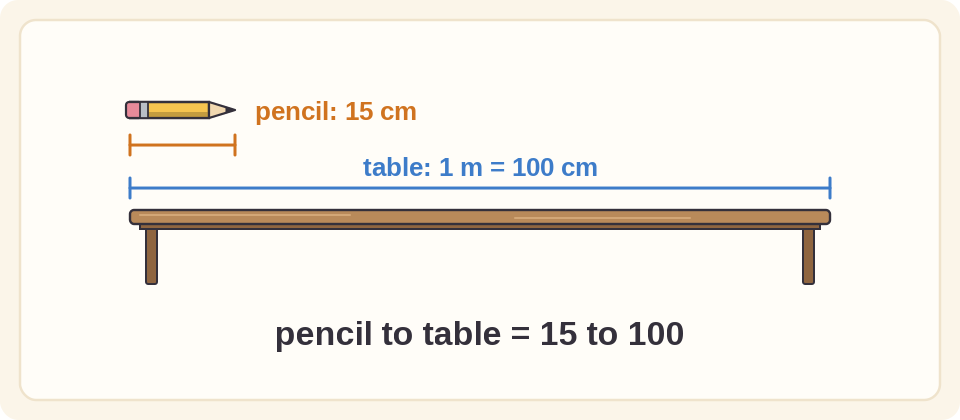
A pencil is 15 centimeters long and a table is 1 meter long. The ratio is not 15 to 1: that would say the pencil is longer!
Write both in the same unit first. 1 meter is 100 centimeters, so the ratio is 15 to 100.
Try it at home
- Count the forks and the spoons in a drawer.
- Write the ratio of forks to spoons in three ways.
- Write the ratio of forks to all the forks and spoons together.
Words in this lesson
- ratio - a comparison of two amounts, like 3 to 5, 3:5 or 3/5.
- part to whole - a ratio of one part to the whole group, like orange fish to all the fish.
Big idea
A ratio compares two amounts in order; write them in the same unit first.