Square and Cube Numbers
Why is 4² read "4 squared" and 4³ read "4 cubed"? The names come from the shapes these numbers make.
Squared
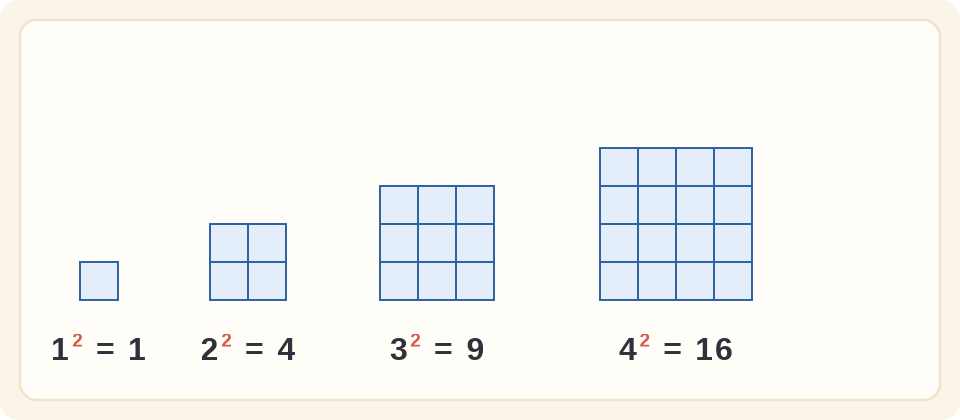
Lay tiles in a square 4 long and 4 wide. There are 4 × 4 = 4² = 16 tiles.
That is why the exponent 2 is called squared. The numbers 1, 4, 9, 16, 25, 36... are the square numbers: 1², 2², 3², 4², 5², 6².
Cubed
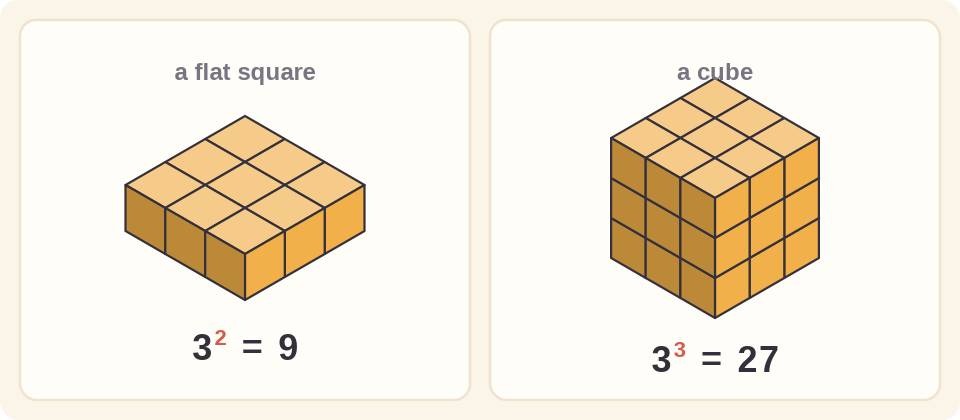
Now stack blocks into a cube 3 long, 3 wide and 3 tall. Each layer is 3 × 3 = 9 blocks, and there are 3 layers.
So the cube has 3 × 3 × 3 = 3³ = 27 blocks. The exponent 3 is called cubed.
The cube numbers start 1, 8, 27, 64, 125: 1³, 2³, 3³, 4³, 5³.
Don't swap them
2⁵ and 5² have the same two numbers but are not equal. 2⁵ = 32, and 5² = 25.
And 3² is 3 × 3 = 9, not 3 × 2 = 6.
Try it at home
- Build a square from coins or tiles, 5 on a side. How many did you use?
- Build a cube from sugar cubes or small blocks, 2 on each edge.
- Write each count as a power.
Words in this lesson
- square number - a number times itself, like 5² = 25: the tiles in a square.
- cube number - a number times itself three times, like 3³ = 27: the blocks in a cube.
Big idea
A number squared is the tiles in a square, and a number cubed is the blocks in a cube.