The Distributive Property
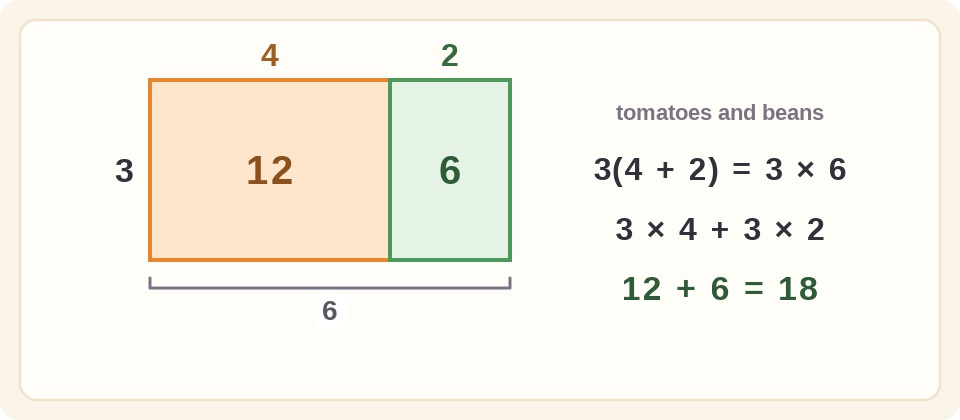
A garden bed is 3 meters wide: 4 meters of tomatoes, then 2 meters of beans. Is its area 3 × (4 + 2), or 3 × 4 + 3 × 2? Both!
Two ways to find one area
The whole bed is 3 by 6, so its area is 3(4 + 2) = 3 × 6 = 18 square meters.
The two parts are 3 × 4 = 12 and 3 × 2 = 6, and 12 + 6 = 18 too.
So 3(4 + 2) = 3 × 4 + 3 × 2: multiply each part, then add. This is the distributive property.
With a letter
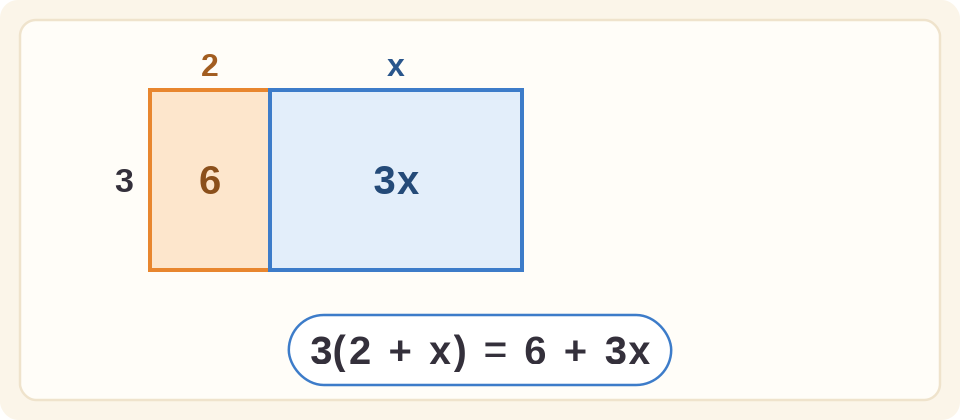
Now one part is x meters long, a length we don't know. The area is 3(2 + x).
Split it: 3 × 2 = 6 and 3 × x = 3x. So 3(2 + x) = 6 + 3x.
Multiply the number outside by every term inside: 4(x + 5) = 4x + 20, and 2(3y + 1) = 6y + 2.
And backwards
6 + 3x has a 3 in both terms, so it can be written 3(2 + x) again. 4x + 8 = 4(x + 2).
Careful
3(2 + x) is not 6 + x. The 3 multiplies the x too.
Try it at home
- Draw a rectangle 5 squares wide and 7 long on squared paper.
- Draw a line to cut it into a 5 by 4 part and a 5 by 3 part.
- Find the area both ways: 5(4 + 3) and 5 × 4 + 5 × 3.
Words in this lesson
- distributive property - a(b + c) = ab + ac: multiplying a sum is the same as multiplying each term and adding.
Big idea
To multiply a sum, multiply each of its terms: 3(2 + x) = 6 + 3x.