Distance, Time and Speed
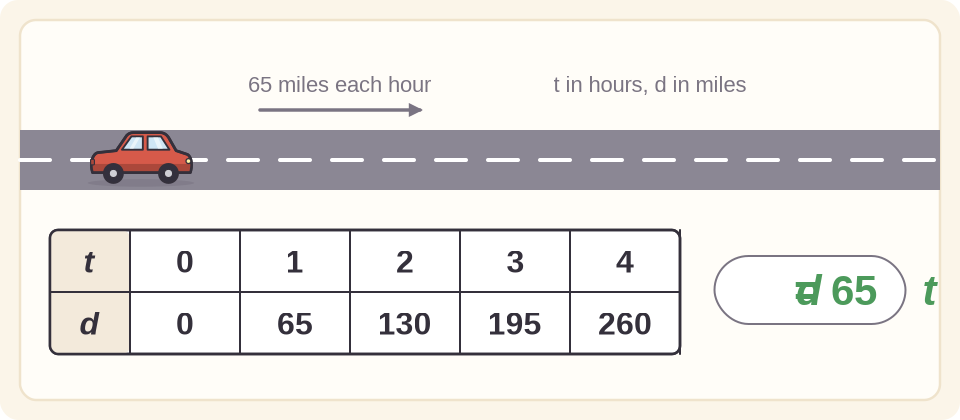
A car on a highway drives at a steady 65 miles per hour. How far does it go in 2 hours? In 4 hours? How long do 325 miles take?
The rule
The time in hours is the independent variable. The distance in miles depends on it.
Each hour adds 65 miles, so .
In 2 hours, miles. In 4 hours, miles.
Going backward
How long do 325 miles take? . Divide both sides by 65: hours.
Check: . True.
Two speeds on one graph
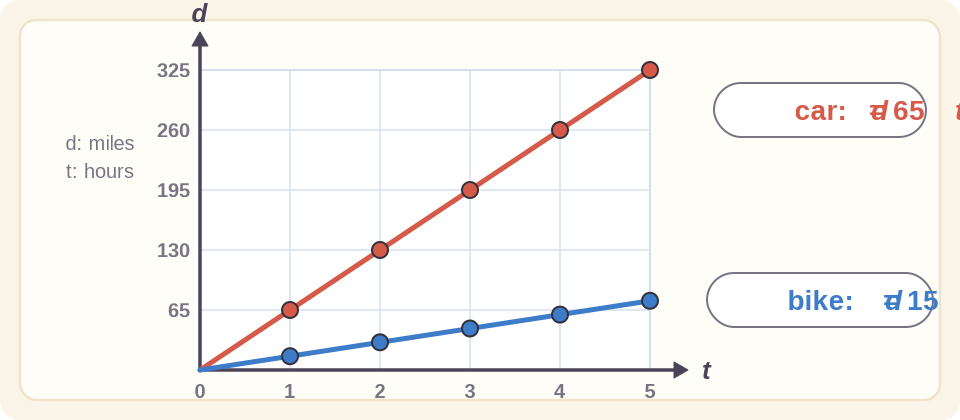
A bike rider goes 15 miles per hour: . Graph both rules on the same grid.
Both lines start at (0, 0), but the car's line is much steeper. It climbs 65 miles each hour, the bike's only 15.
On a distance and time graph, the steeper line is the faster trip.
Try it at home
- Walk at a steady speed for 1 minute and count your steps.
- Make a table of your steps in 1, 2, 3 and 4 minutes, if you kept the same speed.
- Write the rule with m for minutes and s for steps. How many steps would 10 minutes take?
Words in this lesson
- speed - how far something goes in each unit of time, like 65 miles per hour.
- steady - the same distance in every hour (or minute), so the graph is a straight line.
Big idea
At a steady speed, distance is speed times time: the table, the equation and the graph tell the same story.