Divide by Multiplying by the Reciprocal
Finding a common denominator every time is slow. There is a quicker way to divide fractions, and a good reason it works.
Dividing is multiplying by the reciprocal
6 ÷ 2 = 3, and 6 × = 3. Dividing by 2 is the same as taking half.
4 ÷ asks how many thirds fit in 4. Each whole holds 3 thirds, so 4 × 3 = 12.
Dividing by is multiplying by 3, its reciprocal.
Why it works for any fraction
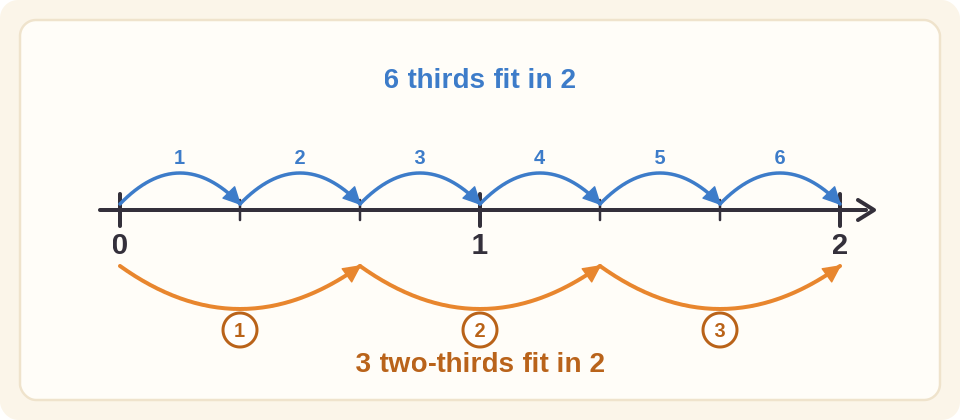
2 ÷ : first, how many thirds fit in 2? 2 × 3 = 6.
But is 2 thirds, twice as long. So only half as many fit: 6 ÷ 2 = 3.
You multiplied by 3 and divided by 2. That is multiplying by , the reciprocal of .
The rule
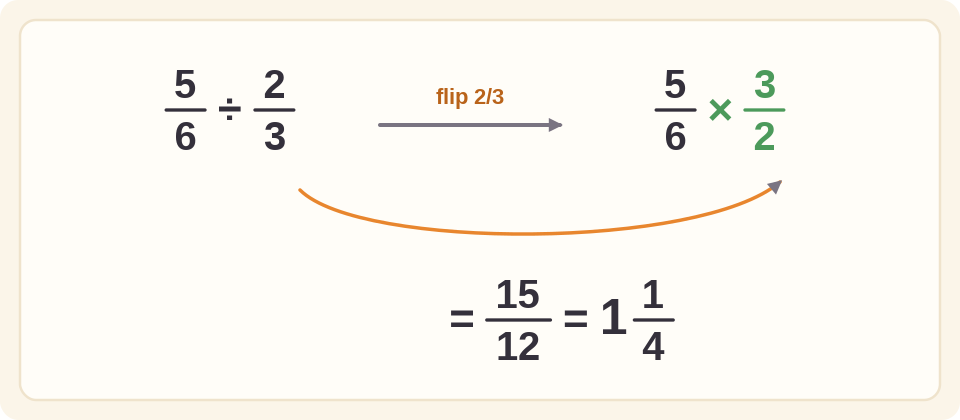
To divide by a fraction, multiply by its reciprocal. People call this invert and multiply.
÷ = × = = . The same answer as with common denominators.
A story: how many -cup servings are in cup of yogurt? × = = 2 servings.
Careful
Flip only the number you divide by, the one after the ÷ sign. The first number stays as it is.
Try it at home
- Work out 3/4 ÷ 1/8 with the rule.
- Then check it: how many eighths fit in 3/4 of a pizza?
- Do both ways give the same answer?
Words in this lesson
- invert - to turn upside down; inverting a fraction gives its reciprocal.
Big idea
To divide by a fraction, multiply by its reciprocal, because that counts how many of it fit.