Dividing by a Decimal the Standard Way
A 2-liter bottle of juice fills cups of 0.25 liter. How many cups?
How many times it fits
Jump by 0.25 on a number line from 0: 0.25, 0.5, 0.75, 1, and on to 2. That is 8 jumps.
So 2 ÷ 0.25 = 8. Dividing by a number less than 1 gives a bigger answer.
Make the divisor whole
Multiply both numbers by 10 or 100 until the divisor is a whole number. The quotient stays the same.
2 ÷ 0.25 = 200 ÷ 25 = 8. 6.3 ÷ 0.7 = 63 ÷ 7 = 9.
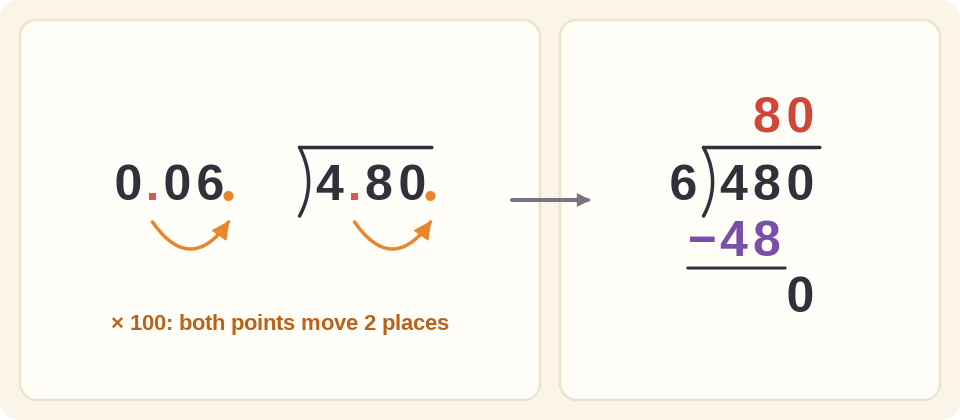
In the long division, move the divisor's point to its end, and move the dividend's point the same number of places, adding zeros: 4.8 ÷ 0.06 becomes 480 ÷ 6 = 80.
Why it stays the same
A division can be written as a fraction: 7.2 ÷ 0.9 is 7.2 over 0.9. Multiply the top and the bottom by 10: = 8.
Equal fractions give the same quotient.
The remainder changes
9 ÷ 4 = 2 R1, but 90 ÷ 40 = 2 R10. The quotient stays; the remainder grows 10 times too.
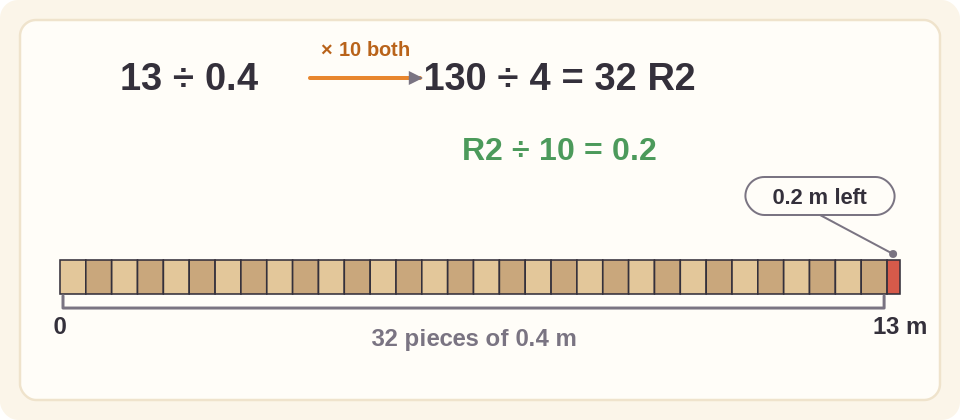
13 ÷ 0.4: times 10, 130 ÷ 4 = 32 R2. Divide the remainder back by 10: 0.2.
Check: 32 × 0.4 + 0.2 = 12.8 + 0.2 = 13.
Careful
The quotient doesn't change, but the remainder does: divide it back by the same 10 or 100.
Try it at home
- Get a 1-liter bottle and a small cup.
- Guess how many 0.2-liter cups it fills. Work out 1 ÷ 0.2.
- Fill the cups to check.
Words in this lesson
- divisor - the number you divide by.
Big idea
To divide by a decimal, multiply both numbers by 10 or 100 to make the divisor whole; the quotient stays, but divide a remainder back.