Multiplying Decimals the Standard Way
A garden bed is 2.4 m long and 1.3 m wide. What is its area?
Multiply without the points
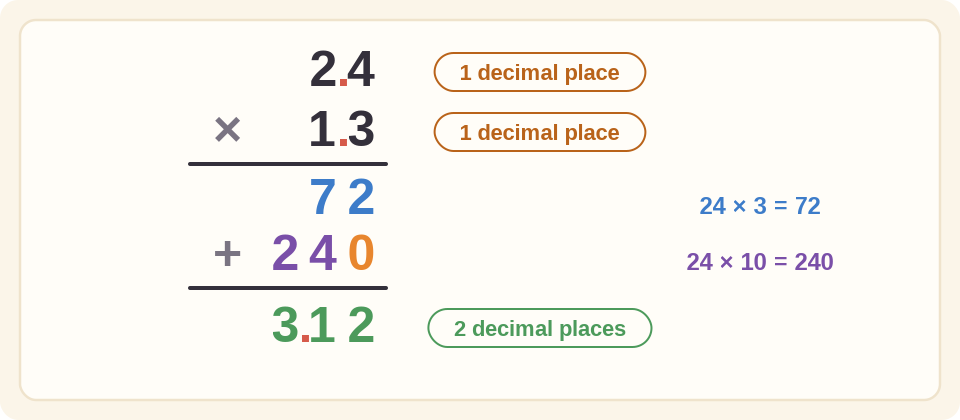
First forget the points: 24 × 13 = 312.
Now count the digits after the point in both numbers: 2.4 has 1 and 1.3 has 1. That is 2 in all.
Give the answer 2 digits after the point, counting from the right: 3.12. The area is 3.12 square meters.
Estimate: 2.4 is about 2 and 1.3 is about 1, so the area is a bit more than 2. 3.12 makes sense; 31.2 would not.
Why counting works
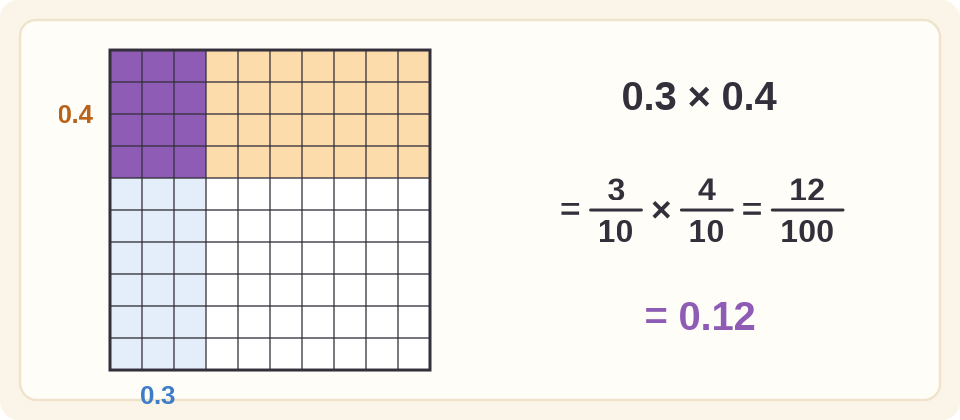
0.3 × 0.4 = × = = 0.12.
Tenths times tenths make hundredths, so 1 place and 1 place make 2 places.
Bigger or smaller?
Multiplying by a number less than 1 makes it smaller: 50 × 0.9 = 45.
× 100 moves every digit 2 places left: 0.06 × 100 = 6. × 0.01 moves them 2 places right: 45.7 × 0.01 = 0.457.
Careful
Put the point in before you drop zeros: a robot moving 0.75 m per step goes 4 × 75 = 300, so 3.00 = 3 m in 4 steps.
Try it at home
- Measure a table or a book in meters, to the tenth.
- Multiply its length by its width to find its area.
- Estimate first with whole numbers. Is your answer close?
Words in this lesson
- decimal place - a place after the decimal point: tenths, hundredths, thousandths.
- product - the answer to a multiplication.
Big idea
Multiply as if there were no points, then give the product as many decimal places as both factors have together.