Comparing Ratios with Tables
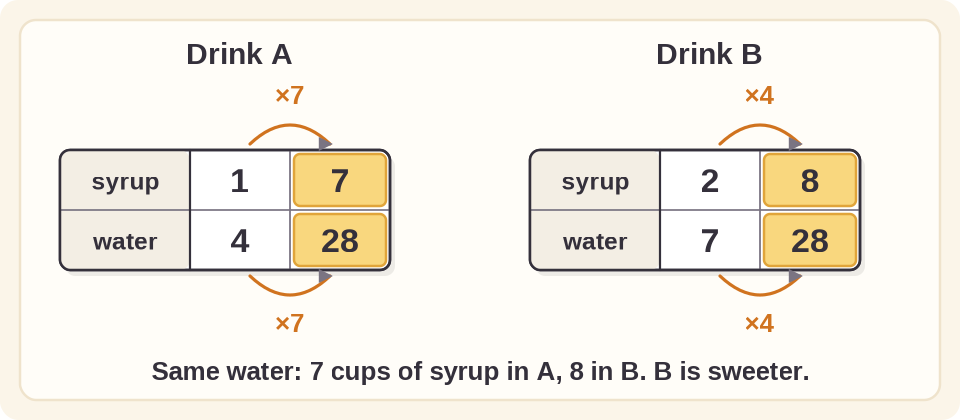
Drink A is 1 cup of syrup to 4 cups of water. Drink B is 2 cups of syrup to 7 cups of water. Which one is sweeter?
Make one amount the same
You can't compare 1 to 4 with 2 to 7 straight away. Make a ratio table for each drink and look for the same amount of water in both.
Count by 4s and by 7s: both reach 28. A needs 7 cups of syrup for 28 cups of water, and B needs 8.
With the same water, B has more syrup, so B is sweeter.
A multiplier that is not whole
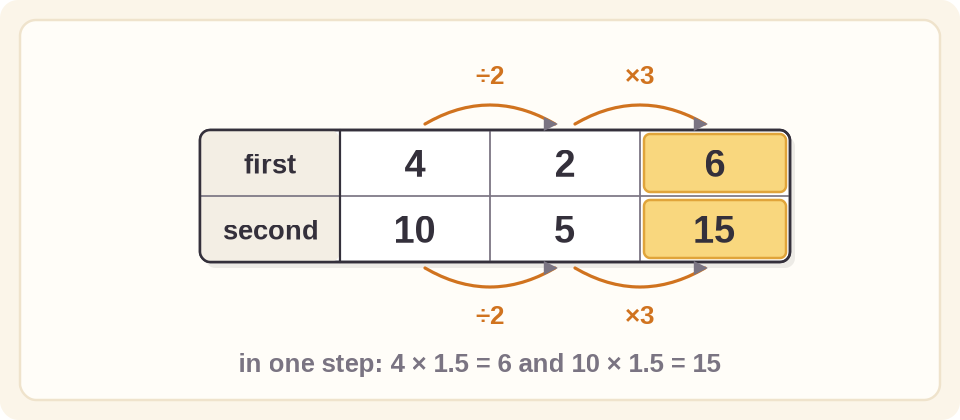
4 to 10 is equal to 6 to what? 4 times a whole number is never 6.
Go through a smaller column first: divide by 2 to get 2 to 5, then multiply by 3 to get 6 to 15.
In one step, 4 times 1.5 is 6, so the multiplier is 1.5, or . And 10 × 1.5 = 15.
Adding breaks a ratio
A boy is 2 and his sister is 4, so she is twice his age: 2 to 4, or 1 to 2.
In 10 years they will be 12 and 14. 12 to 14 is 6 to 7, not 1 to 2. Adding the same number to both amounts does not keep a ratio.
Try it at home
- Mix 1 spoon of juice with 3 spoons of water in one glass, and 2 spoons with 5 in another.
- Make a ratio table for each to predict which is stronger.
- Taste them. Were you right?
Words in this lesson
- equivalent ratios - ratios that make the same mix, like 2 to 5 and 6 to 15.
Big idea
To compare two ratios, use tables to make one of the amounts the same, then compare the other.