Multiplying Can Make Smaller
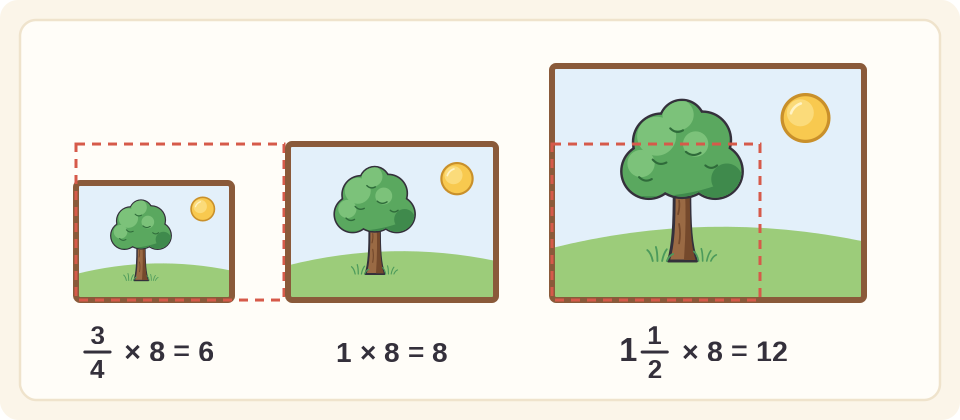
Sam's picture is 8 inches wide. He makes a copy as wide, and another times as wide. Which copy is wider than the picture? You can tell without multiplying.
Times a fraction less than one
× 8 means of 8. That is only part of 8, so it is less than 8. It is 6.
Multiplying by a number less than 1 makes a number smaller.
Multiplying by exactly 1 keeps it the same: 1 × 8 = 8.
Multiplying by a number more than 1 makes it bigger: × 8 = 12.
Two fractions less than one
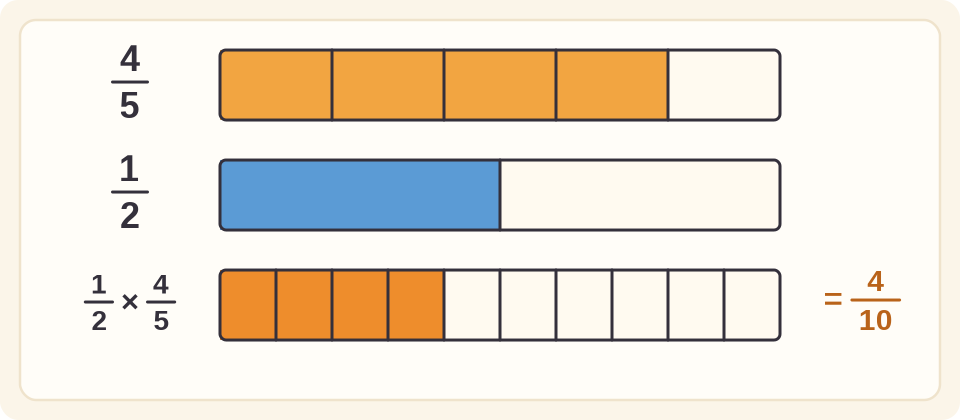
What about × ? It means half of , so it is less than .
It is also of , so it is less than too.
The product is smaller than both. Check: < .
Try it at home
- Take a cup of dry rice or beans.
- Pour out about 1/2 of it. Is it more or less than the cup you started with?
- Guess first: is 2/3 × 9 more or less than 9? Then work it out.
Words in this lesson
- scale - to make something bigger or smaller by multiplying.
Big idea
Times a number less than 1 makes smaller, times 1 keeps the same, times more than 1 makes bigger.