Writing an Expression
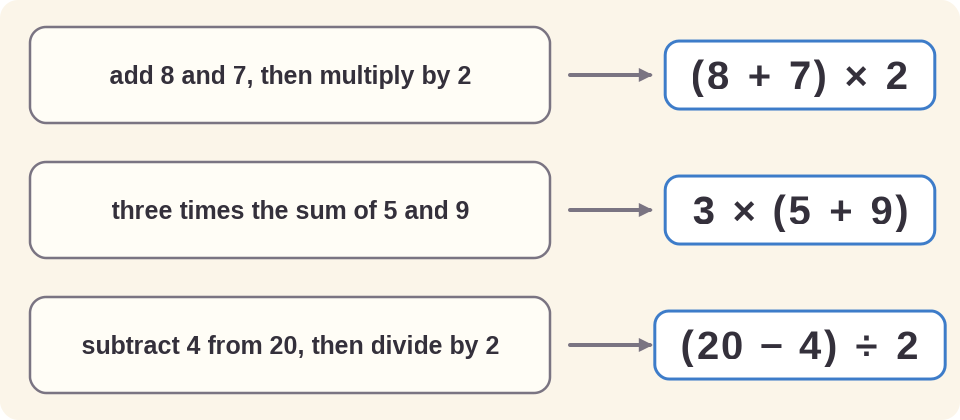
Your teacher says: add 8 and 7, then multiply by 2. Can you write that in numbers and signs, without working it out?
Words into signs
"Add 8 and 7" is 8 + 7. "Then multiply by 2" comes after.
If you write 8 + 7 × 2, the rules say multiply first. That gives 22, the wrong answer.
So put the first step in parentheses: (8 + 7) × 2. Now the adding comes first.
"Three times the sum of 5 and 9" is 3 × (5 + 9).
"Subtract 4 from 20, then divide by 2" is (20 - 4) ÷ 2.
An expression for a story
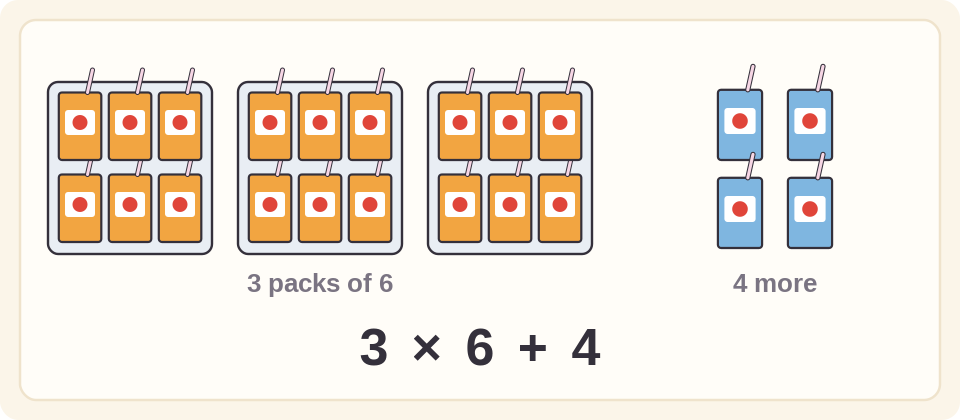
Hana buys 3 packs of 6 juice boxes. She also has 4 juice boxes at home.
The packs are 3 × 6. The extra boxes are + 4. So she has 3 × 6 + 4.
No parentheses are needed here, because multiplying comes first anyway.
3 × (6 + 4) would be 3 packs of 10. That is a different story.
Try it at home
- Make up a story with groups of things, like 4 bags of 5 apples and 2 more.
- Write an expression for it.
- Ask someone to tell a story for 2 × (3 + 5).
Words in this lesson
- expression - numbers and signs that stand for an amount, like 3 × 6 + 4.
Big idea
To write words as an expression, put the step that comes first in parentheses when the rules wouldn't do it first.