Solve a Simpler Problem First
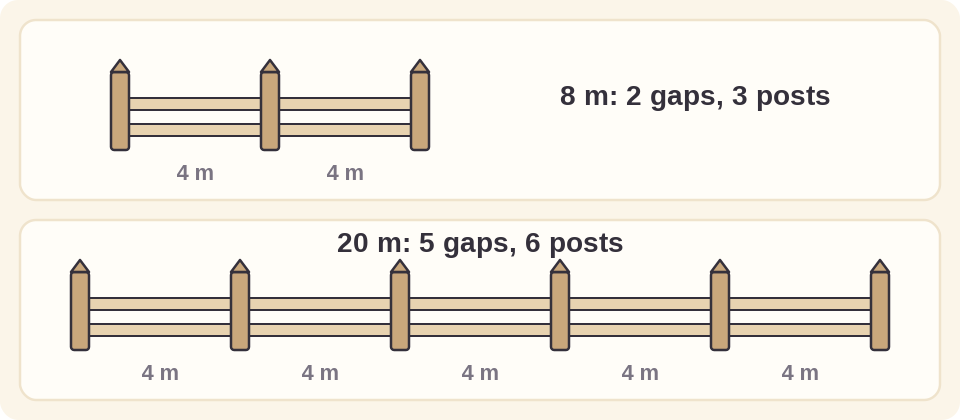
A fence is 20 meters long. It has a post every 4 meters, and one at each end. How many posts are there? Many people say 5. Are they right?
Try small numbers and draw
Make the problem smaller. Take a fence 8 meters long.
Draw it. There is a post at 0, at 4 and at 8. That is 3 posts, not 2!
There is always one more post than there are gaps.
Now the real fence: 20 ÷ 4 = 5 gaps, so 6 posts.
One small question at a time
A printer prints 30 pages a minute. How many pages does it print in 2 hours?
First question: how many minutes is 2 hours? 2 × 60 = 120 minutes.
Second question: 120 × 30 = 3,600 pages.
Splitting it into small questions made each step easy.
Make it round first
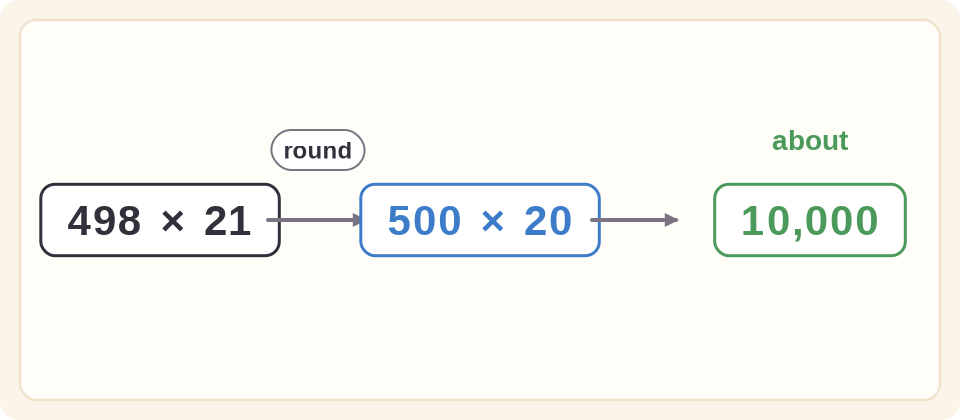
Before working out 498 × 21, make the numbers simpler: 500 × 20 = 10,000.
Now you know the answer is about 10,000. If you get 1,000 or 100,000, check again.
Try it at home
- Put 5 spoons in a row with a gap between each.
- Count the gaps. Is it one less than the spoons?
- How many spoons would make 10 gaps?
Words in this lesson
- strategy - a plan for solving a problem.
Big idea
When a problem is hard, try smaller numbers, split it into small questions, or round first.