Parts and the Whole
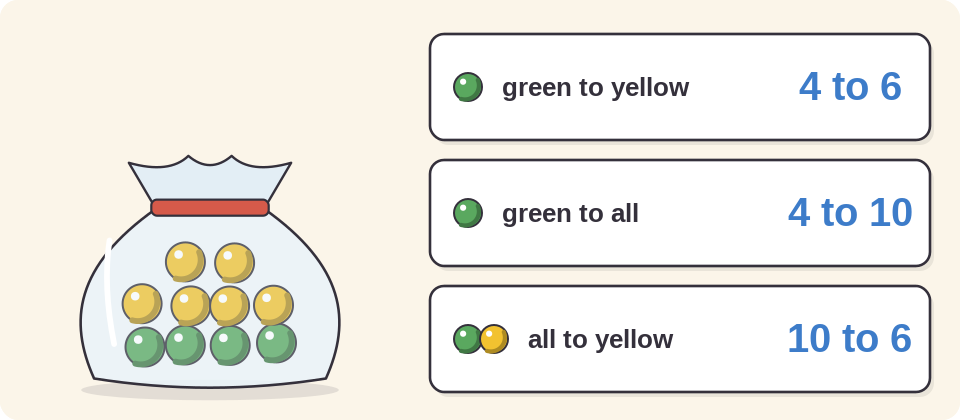
Leo's bag has 4 green marbles and 6 yellow marbles. Should he compare the green ones with the yellow ones, or with all the marbles? Both are ratios.
Part to part, part to whole
Green to yellow compares one part with the other part: 4 to 6.
Leo has 4 + 6 = 10 marbles in all. Green to all the marbles is 4 to 10.
This compares a part with the whole. It is a fraction you know: of the marbles are green.
The whole can come first too: all the marbles to yellow is 10 to 6.
Use the same unit
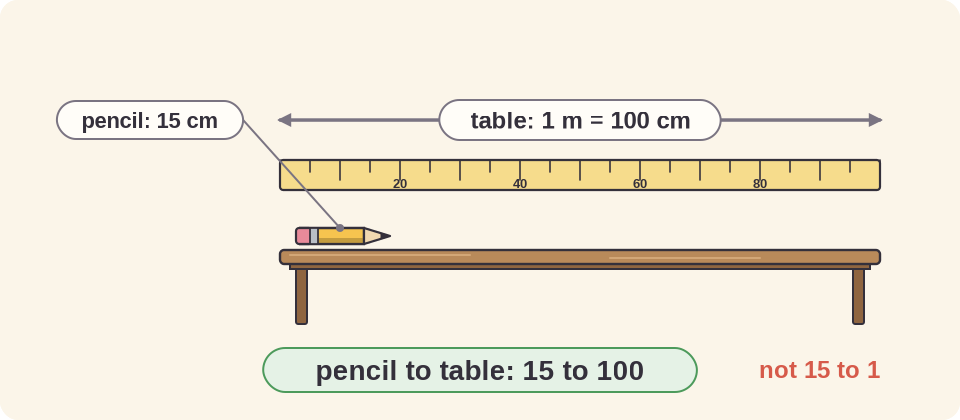
A pencil is 15 centimeters long. A table is 1 meter long.
Is the ratio of the pencil to the table 15 to 1? That would say the pencil is longer than the table!
First write both lengths in the same unit. 1 meter is 100 centimeters.
So the ratio of the pencil's length to the table's length is 15 to 100.
Try it at home
- Count the people who live in your home: how many are children, and how many are grown-ups?
- Write the ratio of children to grown-ups, then children to everyone.
- Which of the two ratios is a fraction of your family?
Words in this lesson
- part-to-whole ratio - a ratio that compares one part with all of them, like 4 green marbles to 10 marbles.
Big idea
A ratio can compare a part with a part, or a part with the whole; write both amounts in the same unit first.